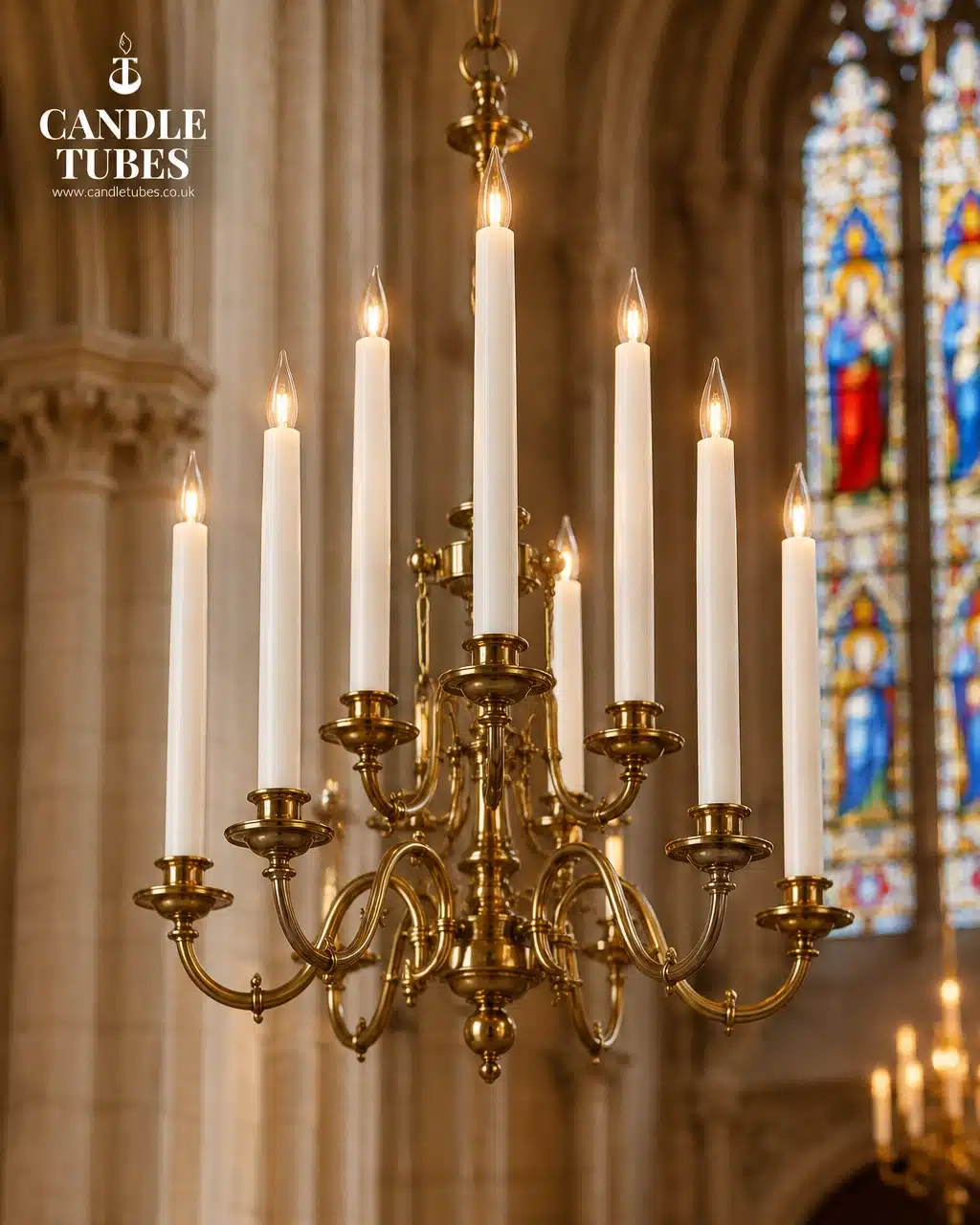
A chandelier can be beautifully made yet still look strangely unbalanced once its chandelier candles have been replaced. Often, the problem is not the frame, the crystal or the finish. It is the relationship between the candle tubes, candle sleeves, chandelier candle covers, bulbs and lampholders.
A tube that is only a few millimetres too narrow, too short or too far above the arm can change the entire character of a fitting. The good news is that correcting the proportions is usually straightforward once you stop guessing and start measuring.
At Candle Tubes UK, we manufacture bespoke candle tubes and restoration components for chandeliers, lamps and lights. Here is our practical guide to identifying the problem and choosing a better-fitting solution.
Why do chandelier candles look wrong when the fitting itself is beautiful?
The eye reads a chandelier as a collection of relationships. Every arm, drip pan, candle tube and bulb should look as though it belongs to the same design.
Common causes of an unbalanced appearance include:
- Candle tubes that are too short or too tall.
- An outer diameter that looks too thin for the arm or drip pan.
- An internal diameter that does not properly clear the lampholder.
- Exposed lampholders, wiring or mounting hardware.
- Bulbs sitting too low, too high or at different heights.
- A mixture of finishes, colours or profiles across the chandelier.
- Replacement parts selected from a photograph rather than measured from the original.
A useful rule of thumb is this: the candle tube should visually connect the arm to the bulb without drawing attention to the electrical hardware underneath. It provides the decorative candle appearance, but it is not itself an electrical component.
Candle tubes, sleeves and covers must therefore be selected alongside the correct lampholders and bulbs. They should never be treated as a universal “one size fits all” accessory.

Is the candle tube too short or too tall?
Height is one of the first things to check. A short candle tube may leave too much of the lampholder visible, making the fitting look unfinished. A tube that is excessively tall can make the chandelier appear top-heavy or obscure too much of the bulb.
The finished height should be considered in relation to:
- The height and shape of the original candle tube.
- The depth of the drip pan or bobèche.
- The position of the lampholder.
- The height and profile of the bulb.
- The length and curve of each chandelier arm.
- The height at which the fitting will hang in the room.
The correct dimension depends on the original fitting. There is no prudent universal height that will suit every chandelier.
If your chandelier hangs at eye level or in a passageway, a very tall tube and exposed bulb may create an uncomfortable visual obstruction. Conversely, if you have generous ceiling height (lucky you!), a more substantial candle proportion may be needed to preserve the chandelier’s presence in the room.
The aim is for the tube and bulb to read as one convincing candle form. The bulb should appear to rise naturally from the decorative sleeve rather than float above it or disappear inside it.
Could the outer diameter be making your chandelier look thin?
Diameter affects visual weight. A narrow candle tube can look lost on a large gilt, bronze or crystal chandelier. A tube that is too wide may overwhelm a petite French arm or prevent the decorative cover from seating correctly.
Compare the apparent width of the tube with:
- The opening or well in the drip pan.
- The thickness of the chandelier arm.
- The shape of the original nozzle.
- The scale of nearby decorative details.
- The width of the bulb selected for the fitting.
The French GS Range has a 22mm cylinder diameter, giving it a slimmer, more delicate appearance. It can be a suitable choice where the original fitting calls for a narrow French-style candle profile.
The English Regency Range has a 30mm base with a tapered profile, creating a broader and more substantial visual transition from the arm to the upper candle.
These are not interchangeable styles simply because both may be described as candle tubes. A 22mm French GS cylinder can look under-scaled on a robust Regency arm, while a 30mm-based English Regency profile may look too heavy on a petite French fitting.
Peruse the French GS E10 candle range and the New English Regency range, but use the original component and the fitting itself as your reckoner.
Are exposed lampholders and hardware spoiling the candle effect?
A decorative candle cover is intended to conceal or visually integrate the lampholder assembly. If too much of the lampholder, threaded section, wiring or fixing hardware is visible, the illusion is quickly lost.
Before ordering replacements, inspect:
- The full outer shape of the lampholder.
- Any shoulder, skirt or flange.
- The threaded mounting arrangement.
- The point at which the lampholder sits inside the arm or drip pan.
- Whether the original tube covered the whole assembly or only part of it.
Do not assume that a tube’s advertised outer diameter tells you whether it will fit. The internal diameter and internal clearance are equally important. The sleeve must clear the actual lampholder without being forced, pinched or left visibly loose.
This is where a generic replacement can disappoint. The outside may look close, yet the inside can be wrong for the fitting. A bespoke candle tube is made around the dimensions required rather than around an approximate visual match.
Are the bulbs sitting in the wrong position?
Bulb position can make correctly sized candle tubes look incorrect. If the bulb sits too low, the candle appears squat. If it sits too high, the lampholder and tube may look disconnected.
First identify the fitting designation:
- E10 means MES : Miniature Edison Screw.
- E14 means SES : Small Edison Screw.
- E12-UL is a separate fitting designation used for suitable North American applications.
The bulb must match the lampholder. An E14 SES bulb should not be fitted into an E10 MES lampholder, and an E12-UL fitting should not be treated as interchangeable with either.
For the French GS look, we recommend the E10 miniature flame-tipped bulb pairing, sometimes described in product copy as an “E10 miniature SES Flame Tipped Bulb”. However, the technical designation should always be checked carefully: E10 is MES, while SES properly refers to E14.
When choosing a bulb, consider its:
- Base designation.
- Overall height.
- Flame or tip shape.
- Width in relation to the candle tube.
- Final position above the sleeve.
For electrical compatibility, wiring, installation and any changes to an existing chandelier, consult a qualified electrician. Candle tubes and covers are decorative components; they do not replace the electrical function of the lampholders.
Could inconsistent finishes be affecting the proportions?
Colour and finish alter how large or small a candle appears. A bright white cover can look visually sharper and more prominent than an ivory or beeswax-coloured one. A metallic finish can make a slim component appear heavier, while a translucent finish may reduce its visual weight.
Check whether every arm has the same:
- Candle tube material.
- Colour and surface finish.
- Taper or cylinder profile.
- Drip detail, if used.
- Finished height.
- Relationship with the bulb.
A mixture of ivory, bright white and aged finishes can make a chandelier look assembled from unrelated parts, even when the dimensions are close. For restoration work, the most successful result is usually the one that respects the existing metalwork, glass and patina rather than introducing an overly stark new contrast.

How should you measure chandelier candle tubes?
Use this proportion checklist before ordering:
-
Identify the fitting and style
Establish whether the fitting is French GS, English Regency or another design. Look for the original tube, even if it is damaged. -
Remove and retain the original component
Do not discard a broken sleeve or cover. It may contain valuable evidence of the original height, profile and mounting arrangement. -
Measure the original tube
Record the finished height, outer diameter, internal diameter, base shape and any rebate, shoulder or taper. -
Measure the lampholder assembly
Check the outside dimensions of the actual lampholder, including skirts, shoulders and threaded sections. Do not measure only from a photograph. -
Confirm internal clearance
The replacement tube must clear the lampholder and any wiring or fixing detail without excessive movement or pressure. -
Choose the finished height
Compare the original height with the arm, drip pan and bulb position. Avoid selecting a length purely because it is readily available. -
Check the bulb position
Confirm that the bulb designation matches the lampholder and that the flame tip sits naturally above the decorative sleeve. -
Compare every chandelier arm
Multi-arm fittings can contain small variations caused by previous repairs. Check the components together so the final set remains consistent.
It is not as complicated as it looks, but accuracy matters. A digital calliper is useful for cylindrical parts; for unusual profiles, a clear drawing and several measurements are better than one approximate dimension.
What if the original candle tube is missing or damaged?
This is common with older chandeliers. Card tubes may have deteriorated, glass covers may have broken and previous restorations may have introduced mismatched plastic parts.
Candle Tubes UK offers fully bespoke, made-to-order manufacturing for new components and restoration replacements. Through our specialised digital measurement service, you can send us an original component for accurate assessment : even if it is damaged or incomplete.
We can help assess the required:
- Material.
- Profile.
- Internal and external dimensions.
- Finished height.
- Bulb and lampholder arrangement.
- Colour and decorative finish.
We also work with a collective of specialist decorators and artists for custom finishing, including carefully matched decorative effects where appropriate.

How can you get the proportions right first time?
Begin with the original fitting, not a catalogue photograph. Photographs are useful for identifying a general style, but perspective, lens distortion and camera angle can make a 22mm tube look much like a 30mm tube. They cannot confirm internal clearance, lampholder position or finished height.
For advice about bespoke chandelier restoration parts, candle sleeves, candle socket covers, E10 candle tubes or E14 lampholders, contact Rachel’s office on 0330 113 7842.
You can also explore our chandelier components and lighting range or read our guide to candle tube restoration.
Visit Candle Tubes UK worldwide:
With the correct measurements, a consistent finish and the right bulb-to-lampholder pairing, your chandelier candles can restore the balanced, lavish appearance the fitting was designed to have.