When it comes to the world of bespoke lighting restoration and high-end chandelier design, the difference between "good" and "magnificent" often comes down to just a few millimetres. It’s a subtle game of proportions, one that many DIY enthusiasts and even seasoned interior designers can find a bit daunting at first.
At Candle Tubes UK, we often find our clients stuck in a bit of a quandary: should you stick with the standard E14 (the Small Edison Screw you likely have in every bedside lamp) or scale down to the more delicate E10 (the Miniature Edison Screw)?
Choosing the right candle tube is a prudent step in ensuring your fixture doesn't just work, but truly sings. In this guide, we’ll demystify the technical jargon, compare the visual impact of these two sizes, and help you decide when "less" is definitely "more."
What exactly is the technical difference?
Before we get into the aesthetics, let’s talk shop. If you’ve ever fumbled with a bulb and found it simply won't screw in, you’ve likely met the difference between these two "E" codes (which, by the way, stands for Edison Screw, a bit of industry trivia for your next dinner party).
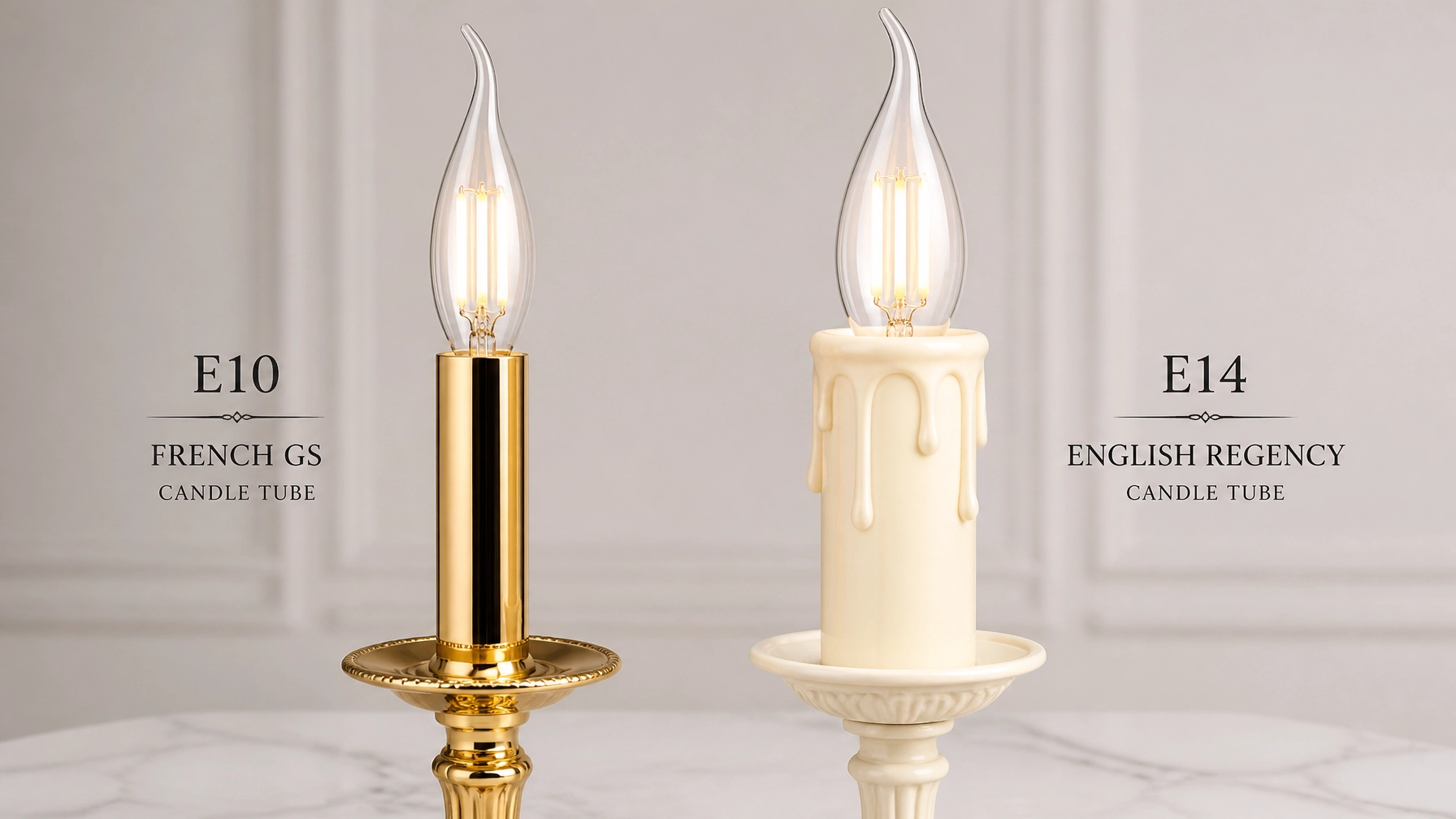
- E14 (SES – Small Edison Screw): This is the "Goldilocks" of the lighting world, not too big, not too small. The socket diameter is approximately 14mm. It is the standard for most UK and European chandeliers, including our popular English Regency Candle range.
- E10 (MES – Miniature Edison Screw): This is the slender sibling. With a socket diameter of roughly 10mm, it’s significantly narrower. You’ll often find these on vintage continental fixtures, particularly in our French GS Candle (formerly known by a different brand name) collection.
(Top tip: Always check your lampholder before ordering! If you're unsure, you can peruse our measurement guide to avoid any nasty surprises.)

Why would you choose the E10 "French GS" profile?
There is a certain "je ne sais quoi" about a slimmer candle tube. While the E14 is dependable and widely available, the E10 offers a level of refinement that can completely transform a lighting fixture.
1. Delicate Crystal and Intricate Metalwork
If you are working on a lavish crystal chandelier with spindly arms and intricate glass droplets, a thick E14 tube can look a bit… well, "clunky." Scaling down to an E10 French GS tube allows the metalwork to breathe. It keeps the focus on the crystals rather than the hardware.
2. Multi-Arm "Statement" Fixtures
For chandeliers with 12, 18, or even 24 arms (lucky you if you have the ceiling height for those!), using E14 tubes can create a "crowded" look. By using E10 sleeves, you reduce the visual "weight" of the fixture, making the entire piece feel more airy and sophisticated.
3. Slimline Wall Sconces
Wall lights are often at eye level, meaning any disproportion is immediately obvious. A bespoke E10 tube on a slim sconce creates a sleek, vertical line that is incredibly pleasing to the eye.
The Case for E14: The "English Regency" Classic
While we love the slim profile of the E10, the E14 English Regency Candle remains a staple for a reason. It has a presence. If your fixture is made of heavy cast brass or has substantial wooden elements, the E14 provides the necessary "heft" to balance the design.

The E14 also offers a wider variety of bulb options: from vintage-style filament bulbs to our modern Smart WiFi range for home automation. If you need a high light output to illuminate a large dining room, the E14 is usually the way to go, as it typically supports higher-wattage LED equivalents.
A "Rule of Thumb" for Proportions
When you’re standing on a ladder trying to visualise the finished look, keep this "reckoner" in mind:
- Tube Diameter: Most E10 tubes hover around the 21mm to 23mm mark (outer diameter). E14 tubes usually start at 25mm and can go much wider.
- The "Rule of Thirds": We generally recommend that the height of your candle tube should be roughly two-thirds of the total height of the "candle" unit (including the bulb). If the tube is too short, the bulb looks like it's "floating." Too tall, and it looks out of proportion with the rest of the fixture's arm.
- Safety First: Regardless of which you choose, always ensure there is at least a 2mm gap between the top of the lampholder and the top of the tube. This prevents heat build-up and ensures a secure fit.

Achieving the "Wow" Factor with Custom Finishes
Whether you choose E10 or E14, the finish is what creates the true "wow" factor. At Candle Tubes UK, we don't just stop at size. We collaborate with a collective of specialist decorators to offer bespoke finishes that you won't find anywhere else.
Perhaps you want a French GS tube in a high-gloss metallic gold to match a gilded Parisian fixture? Or maybe a set of English Regency tubes with hand-waxed drips for an authentic 18th-century look? We can even provide prestigious materials like Glass, Nylon, and our translucent Quartz range for a truly ethereal finish.

Still unsure? Let us do the measuring!
It’s not as complicated as it looks, but we understand that precision is paramount: especially when ordering bespoke, made-to-order products (we are unable to accept returns on these custom parts, so we want you to get it right the first time!).
This is where our specialized digital measurement service comes in. If you have an original part: even a broken one: you can send it to our workshop in Corby. We will digitally measure it to the millimetre to ensure your new candle sleeves provide a perfect, seamless fit.
Whether you are a professional restorer working on a historic estate or a homeowner looking to refresh a beloved heirloom, we are here to help you navigate the nuances of E10 vs E14.
Final Thoughts
Choosing between E10 and E14 is more than just a technical decision; it’s a design choice. By scaling down to an E10 for your more delicate fixtures, you’re not just replacing a part: you’re elevating the entire aesthetic of your room.
Ready to find your perfect fit? Explore our full range of bespoke candle tubes at: