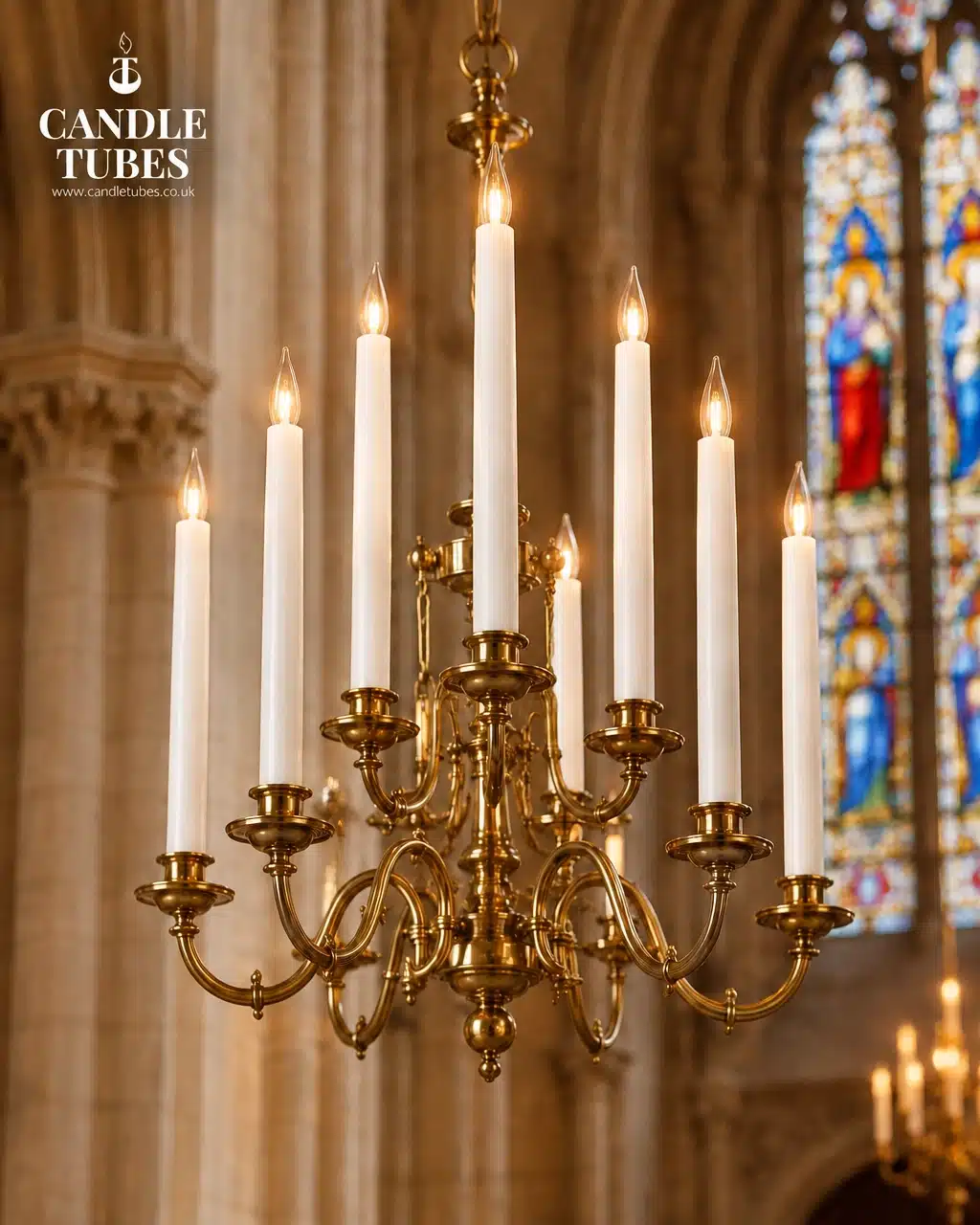
Illustrative rendering of a large candle-tube chandelier in a cathedral nave; this is not product photography.
Replacing candle tubes on a church or cathedral chandelier is rarely a matter of choosing a familiar domestic size and ordering enough for every arm. Large fittings, tall naves and long viewing distances all change how a candle tube looks in place. A component that seems generously sized at arm’s length may appear surprisingly small from the floor below.
For heritage lighting professionals, church architects, cathedral fabric committees, DAC advisers, restorers and stonemasons’ teams, the prudent starting point is to consider both the fitting itself and the scale of the interior. Our Regency Nylon range can be made to order for large-scale restoration, including dimensions beyond standard domestic sizes.
Why are church and cathedral chandeliers a different scale?
A large chandelier must be considered in its architectural setting. Tall naves and long sightlines place the fitting further from the viewer than a typical household light. The chandelier body may be larger, with greater distances between its arms and lampholders, and the candle tubes need to read as part of that larger composition.
That changes the apparent scale. A tube that looks balanced when viewed up close can seem undersized when seen from the nave floor. Conversely, a larger diameter may appear appropriately proportioned in a substantial fitting, where domestic dimensions would look lost.
When assessing an existing chandelier, consider:
- The overall size and character of the chandelier.
- The spacing between its arms and fittings.
- How the tubes look from the main viewpoints below, not only from a ladder.
- Whether surviving originals provide a useful reference for proportion and profile.
A useful rule of thumb: do not judge the replacement only at arm’s length. View it in context, at the distance from which the congregation and visitors will see it.

Illustrative rendering showing the relationship between candle tubes, chandelier scale and a cathedral nave; not product photography.
What does the Regency Nylon range offer for sacred spaces?
The Regency Nylon range serves church and cathedral chandeliers as well as domestic fittings. Its larger made-to-order options are intended for projects where standard domestic sizes simply do not provide the scale required.
Candle tubes can be made with diameters from 45mm upward and heights up to 500mm. Each component is bespoke and made to order in Corby, Northamptonshire.
The available finishes (Plain, Dripped and Waxed) offer different visual effects in a heritage interior:
- Plain: a restrained appearance for quiet authenticity, where a simple candle form best suits the fitting.
- Dripped: a more traditional candle look, with wax-like detailing that adds visual character.
- Waxed: another option for recreating the appearance of a conventional candle on an electric chandelier.
The right finish depends on the character of the fitting and the desired result. A discreet plain tube can sit comfortably in a formal interior, while a dripped or waxed effect may help create a more traditional candlelit impression.

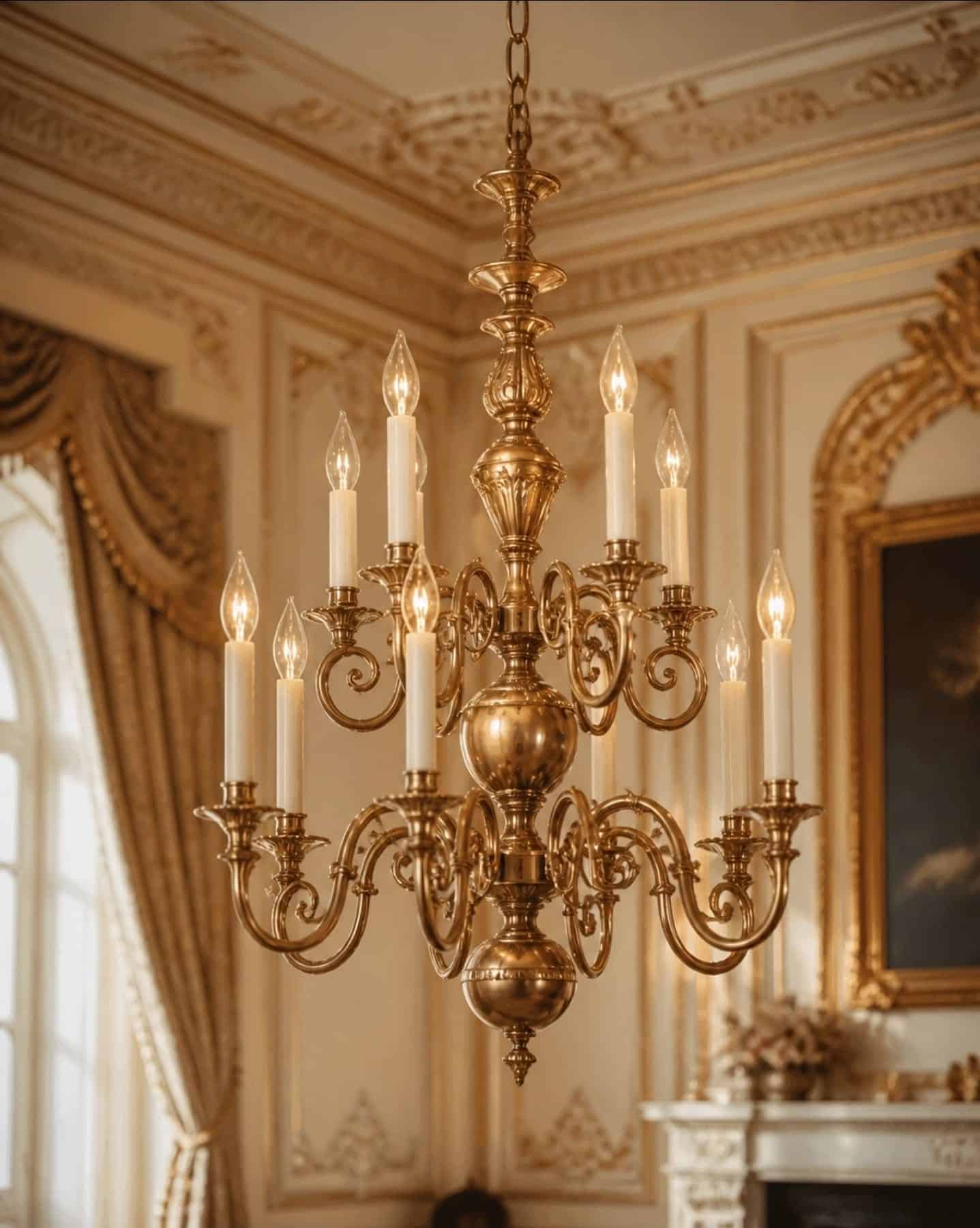
Illustrative rendering of a chandelier arm and candle tube; not product photography.
How should you size candle tubes for a large chandelier?
Measure the fitting rather than guessing from a photograph or assuming that every arm is identical. Diameter and height both affect how the replacement sits on the chandelier and how it appears at a distance.
Where an original candle tube survives, it can provide valuable evidence. Our digital measurement service allows you to send us an original component so we can record its dimensions and make a bespoke replacement. This is particularly useful where an older tube is unusual, where a fitting has been altered, or where the correct size is not obvious.
When no original is available, gather clear measurements from the fitting and consider its intended appearance. If possible, assess a sample in place or compare the proposed dimensions with the chandelier from the nave floor. It’s not as complicated as it looks, but measuring carefully at the outset can help avoid a mismatch across a large fitting.
For a project involving multiple arms, record the chosen dimensions consistently and check whether all positions are alike before ordering. This gives your team a reliable reckoner for the full replacement set.

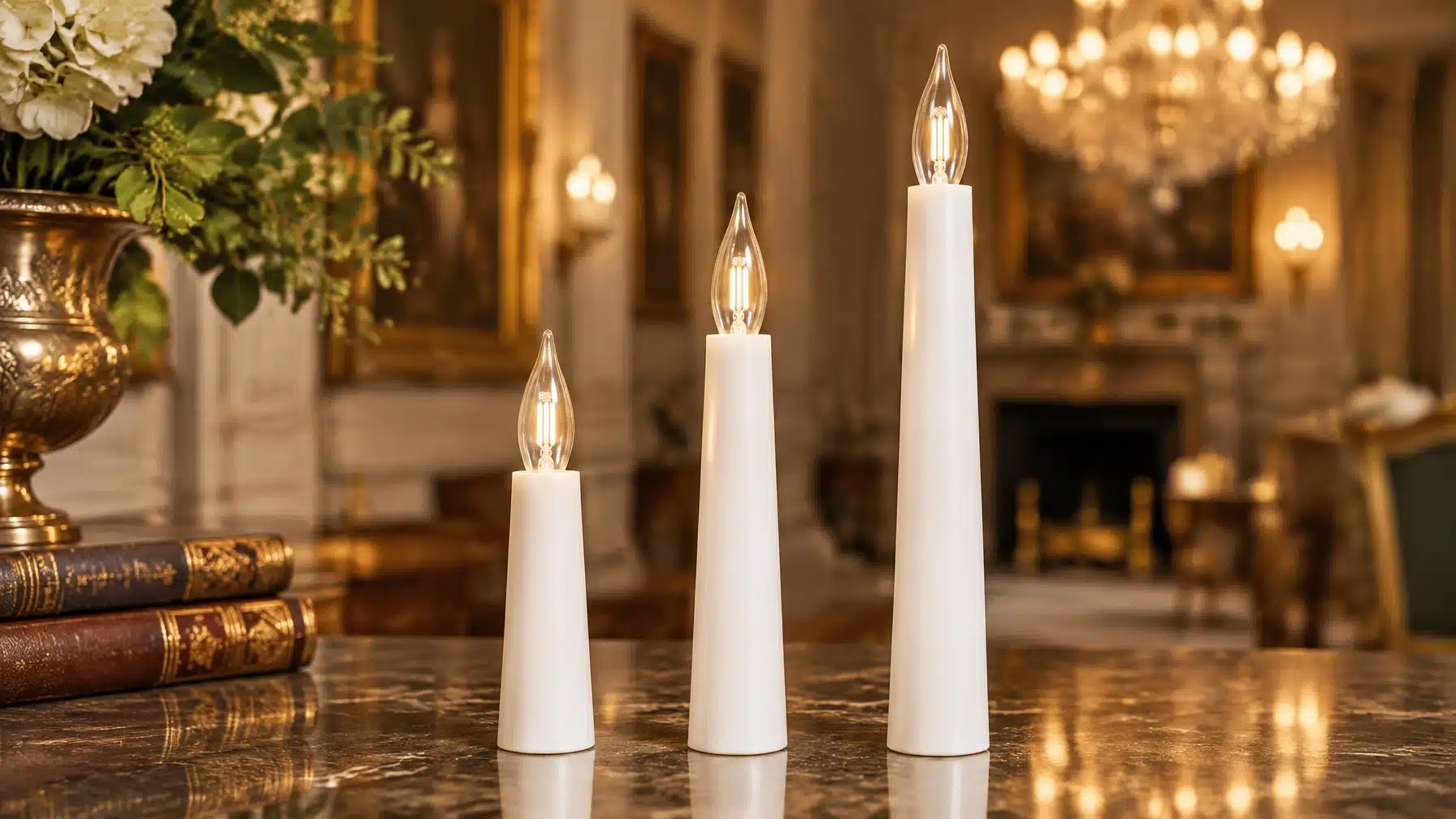
Illustrative rendering of candle tubes at three heights; not product photography.
Which lampholder fitting and electrical details should you check?
Confirm the fitting type as part of your survey. Candle components are available for E10 and E14 European and worldwide fittings, and E12 for American fittings. Do not select a fitting based on appearance alone; confirm it with the project’s electrical professional.
For clarity on the available options: E10/E14 candle components are not UL listed and brackets are earthed; E12-UL working-part options are available for specified USA applications.
Candle tubes and sleeves are decorative components, not electrical parts. All wiring and electrical work must be carried out by a qualified electrician. The decorator’s or restorer’s specification for the visible tube should therefore be coordinated with the professional responsible for electrical work.
How can you keep a large restoration consistent?
Replacing a dozen or more candle tubes calls for a coordinated approach. Even small differences in height, diameter or finish can become noticeable across a large chandelier, particularly when viewed from below.
Before committing to a full batch:
- Establish the required dimensions from the fitting or surviving originals.
- Confirm the finish and profile for the project.
- Check whether multiple arms require identical components.
- Agree the specification before ordering the full quantity.
- Arrange safe, appropriate access for inspection and replacement.
For work at height, a chandelier hoist may bring a large fitting down to working level for maintenance. The method depends on the particular chandelier and site. For an overview of the access approach, see our hotelier’s guide to chandelier hoists. Any access and electrical work should be planned and carried out by appropriately qualified professionals.
Frequently asked questions
Can you make candle tubes for cathedral chandeliers?
Yes. Regency Nylon candle tubes are bespoke and made to order, with diameters from 45mm upward and heights up to 500mm.
Can you work from a surviving original?
Yes. Send us an original candle tube through our digital measurement service, and we can record its dimensions for a made-to-order replacement.
Which bulb fitting should we specify?
The relevant candle components are E10 and E14 for European and worldwide fittings, and E12 for American fittings. Confirm the correct option with your project’s electrical professional.
Can we order single replacements or a batch?
Both single replacements and batches can be discussed. Contact us with the fitting details, dimensions and quantity required so we can advise on the bespoke order.
For advice on a church, cathedral or other large-scale chandelier project, contact Rachel’s office on 0330 113 7842. You can also peruse our information at www.candletubes.co.uk, www.candletubes.com and www.candletubes.eu.
Disclaimer: Candle tubes and sleeves are decorative components only, not electrical parts. A qualified electrician must carry out all work involving wiring.