There is a particular kind of frustration known only to those of us in the lighting world: the "almost fit." You’ve sourced a lavish antique chandelier, uncovered a period fitting during a restoration, or inherited a family light in need of careful refurbishment, only to find that the candle tube is just a fraction too tight for the lampholder, or perhaps it wobbles with a distracting, unrefined gap.
In lighting restoration, that tiny error can undo hours of careful work. A tube that leans, grips too tightly, or sits too high above the cup can spoil the line of a chandelier and create unnecessary fitting headaches. Whether you are a professional restorer, an interior designer, a lighting manufacturer, or a capable DIYer, "near enough" simply isn’t good enough.
That is precisely where Candle Tubes UK’s Digital Measurement Service comes in. We specialise in helping customers solve awkward sizing problems for restoration parts and replacement candle tubes, especially where older chandeliers and non-standard lampholders are involved. If you are unsure how to measure candle tubes for a chandelier, or if you simply do not trust a quick tape-measure reckoner, we can guide you through the process or measure the original part for you to ensure a proper fit.
How Do You Measure Candle Tubes for a Chandelier?
This is one of the most common questions we hear, and rightly so. Candle tubes (also called candle sleeves or candle covers) are simple components, but they need several measurements to fit and look right. The key point is this: you are not just measuring the old tube, you are measuring the part it must fit over and the finished appearance you want to achieve.

As a rule of thumb, there are four measurements worth checking:
- Internal diameter (ID): the most important measurement, as this determines whether the tube will slide neatly over the lampholder body.
- External diameter (OD): useful for matching the visual weight of existing arms and cups on the chandelier.
- Tube height: this affects proportion, glare control, and whether the bulb and lampholder are attractively concealed.
- Base detail or seating point: the way the tube sits on the cup, holder, or bracket matters just as much as the diameter.
For many restorations, the lampholder body is the true starting point. For example, an E14 (Small Edison Screw or SES) lampholder may sound standard, but the body diameter can vary enough to affect the fit. A holder measuring around 22.5mm to 22.7mm will usually call for a carefully chosen internal diameter, often 23mm or 24mm, depending on the material, tolerance, and how snugly you want the tube to sit.
While 0.5mm may sound trivial, in chandelier restoration it is the difference between a sleeve that glides on properly and one that needs a nasty pinch, sits crookedly, or risks damage during installation.
Why a Single Millimetre is the Difference Between 'Right' and 'Wrong'
When you are dealing with prestigious materials, be it our specialised Glass, Nylon, or the classic Regency ranges, the tolerances are tight. If a tube is too wide (say, a 26mm tube on a 22.5mm holder), the candle can lean and spoil the symmetry of a chandelier. If it's too tight, you risk stress on the sleeve, awkward installation, reduced airflow, or cracking the material.
(Top Tip: Always check your bulb cap codes, but do not stop there. An E14 tells you the bulb fitting, not the exact outside diameter of the lampholder body that your candle tube must fit over.)
If you are measuring at home, here is our prudent guide:
- Measure the outside of the lampholder body with digital calipers if possible.
- Take the measurement in millimetres, not inches, for better accuracy.
- Check more than one point on the holder in case the body is slightly tapered or irregular.
- Measure the height of any existing tube from its base to top edge if you want to preserve the original look.
- Photograph the fitting before disassembly, especially on antique chandeliers where proportions matter.
- Never force an old tube off if it seems stuck, as brittle vintage parts can split without much warning.
By utilising our Digital Measurement Service, we remove the guesswork. We do not just rely on "standard" industry sizes; we assess the actual part in front of us and account for the small variations that often make restoration work surprisingly tricky.
Our Digital Measurement Service: How It Works
It’s not as complicated as it looks, and for restorers it is often the most sensible step in the whole process. If you have ever wondered what to do when no catalogue size seems quite right, this is the expert solution.
- Send Us Your Original Part: If you are dealing with a vintage chandelier, a damaged sleeve, or an awkward replacement, you can send us an original tube, lampholder, or related component.
- Precision Digital Analysis: We use high-precision digital calipers and measuring tools to record the critical dimensions, including diameters, seating points, and height requirements.
- Fit Assessment: We consider not just what will physically fit, but what will look correct for the chandelier style and period. (That is an important distinction in restoration work.)
- Prototyping: For larger projects, trade orders, or especially unusual fittings, we can produce a bespoke prototype so you can check the fit before full production.
- Bespoke Manufacturing: Once the measurements are confirmed, we manufacture your candle tubes to those exact specifications in our UK facility.

This service is particularly useful when:
- The original candle tube is missing
- The old sleeve has warped, cracked, or discoloured
- The lampholder has been replaced previously with a non-standard size
- You are matching one surviving arm on a multi-arm chandelier
- You want to avoid ordering several test sizes and hoping for the best
In short, if you are worried about ill-fitting parts, we are set up to solve exactly that problem.
Beyond the Standard: Bespoke and Made-to-Order
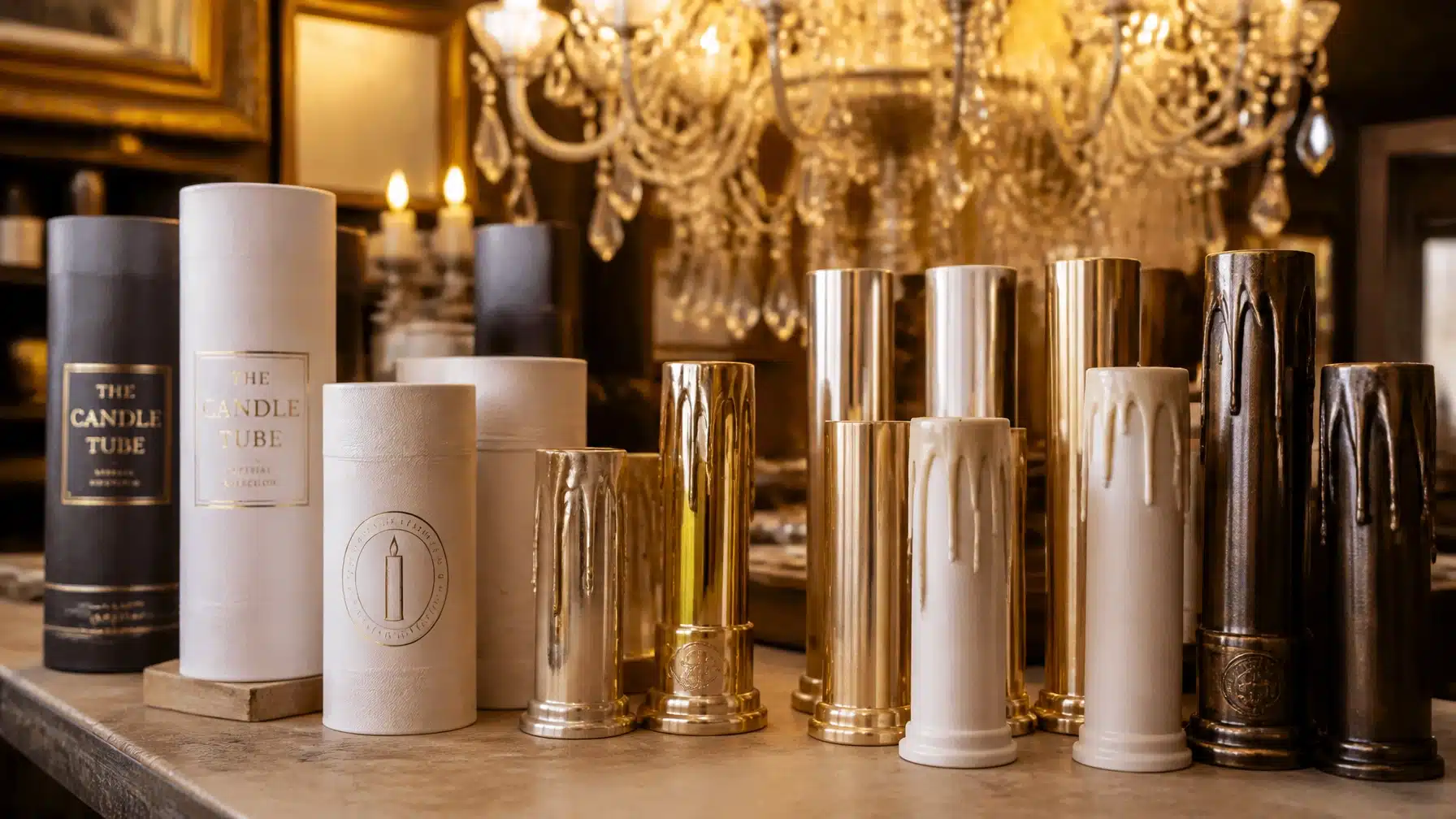
We are the UK's leading manufacturer of bespoke Candle Tubes, and our capability goes far beyond just getting the size right. Our range includes everything from basic Card and Metal to the more prestigious Glass and Nylon options.
For restorers, this matters because an accurate measurement is only half the job; the finished tube must also suit the character of the fitting. Our English Regency and American Regency ranges are brilliant for period-sensitive work, while the French GS Candle offers an elegant profile that many lighting designers favour when the brief calls for refinement and authenticity.

Whether you need a specific waxed drip effect or a clean, modern finish like our chrome or antique copper, we can cater to your vision. Lucky you if you’re working with high ceilings! We can manufacture extra-long tubes that maintain their structural integrity while providing that lavish, elongated look.
Safety First: Avoiding the "Nasty Pinches"
We take safety as seriously as we take aesthetics. An ill-fitting candle tube is not just an eyesore; it can create practical and electrical problems too.
- Heat Dissipation: A tube that is too tight against a lampholder does not allow for proper airflow, which can contribute to overheating.
- Electrical Clearance: Careful measurement helps ensure there is adequate space for wiring, especially when using our adjustable lamp legs.
- Stable Seating: A properly measured tube sits squarely on the bracket or cup, reducing the risk of movement or accidental contact with live parts.
- Safer Installation: Correct sizing means you are less likely to force components together and damage sleeves, holders, or wiring in the process.
If you are carrying out restoration work yourself, a few sensible precautions are always wise:
- Isolate the power fully before removing any parts
- Label arms or components if the chandelier is being dismantled
- Keep one original part aside as your master reference
- Ask for expert guidance if the holder size seems unusual or inconsistent
(Insider Knowledge: If you're working with home automation, ask us about our smart WiFi range which integrates seamlessly with certain product lines.)

Global Quality, Local Expertise
While we are rooted in the UK, our reach is global. We support lighting professionals and DIY enthusiasts across the world through our dedicated domains. Whether you are in London, New York, or Paris, you can access our expertise, bespoke manufacturing, and specialist help with awkward restoration measurements.
We collaborate with a collective of specialist decorators and artists for custom finishing, ensuring that every tube we ship is a work of art in its own right. From the initial digital measurement to the final hand-finished detail, we are here to help you avoid ill-fitting parts and achieve a result that looks considered, balanced, and correct.
If you’re ready to ensure a perfect fit for your next project, we invite you to peruse our full range or contact us about sending in your components for measurement. If you are unsure how to measure candle tubes for chandeliers, we are always happy to point you in the right direction.
Visit us at: