A chandelier that flickers on a dimmer can be both distracting and concerning. Whether the fitting is a cherished period piece, a newly installed statement light or part of a professional restoration, the cause is usually connected to the relationship between the bulbs, dimmer and complete electrical installation.
The decorative components matter too. Choosing the correct bulb base, matching lampholders and a suitable candle tube or sleeve helps you achieve a safe, well-finished result. However, it is important to be clear from the outset: a candle tube cannot cure electrical flicker. It provides the visual finish around the lampholder and bulb; the electrical diagnosis must be considered separately.
Here is our practical guide to identifying the likely causes and specifying the right components.
Why does a chandelier flicker on a dimmer?
There are several possible reasons for chandelier flickering on a dimmer:
- The bulbs are not marked as dimmable.
- The dimmer is not compatible with LED bulbs.
- The dimmer and bulbs have an unsuitable operating range or minimum load.
- Different bulb types or models have been mixed on the same chandelier.
- There may be a loose connection or another electrical fault.
- Voltage fluctuations or wider circuit problems may be affecting the installation.
LED bulbs can reveal irregularities that may not have been noticeable with older incandescent lamps. Flicker can occur when the dimmer alters the electrical waveform but the bulb’s internal driver does not respond smoothly.
If the chandelier flickers only when dimmed, incompatibility between the dimmer and bulbs is a prudent first possibility. If it flickers at full brightness as well, or if other lights are affected, the installation should be checked by a qualified electrician.
Are your chandelier bulbs actually dimmable?
Start by checking the bulb packaging and markings. Every bulb connected to a dimmer should be explicitly marked dimmable. A flame-tipped bulb may look exactly like a dimmable version but still be intended only for use with a standard on/off switch.
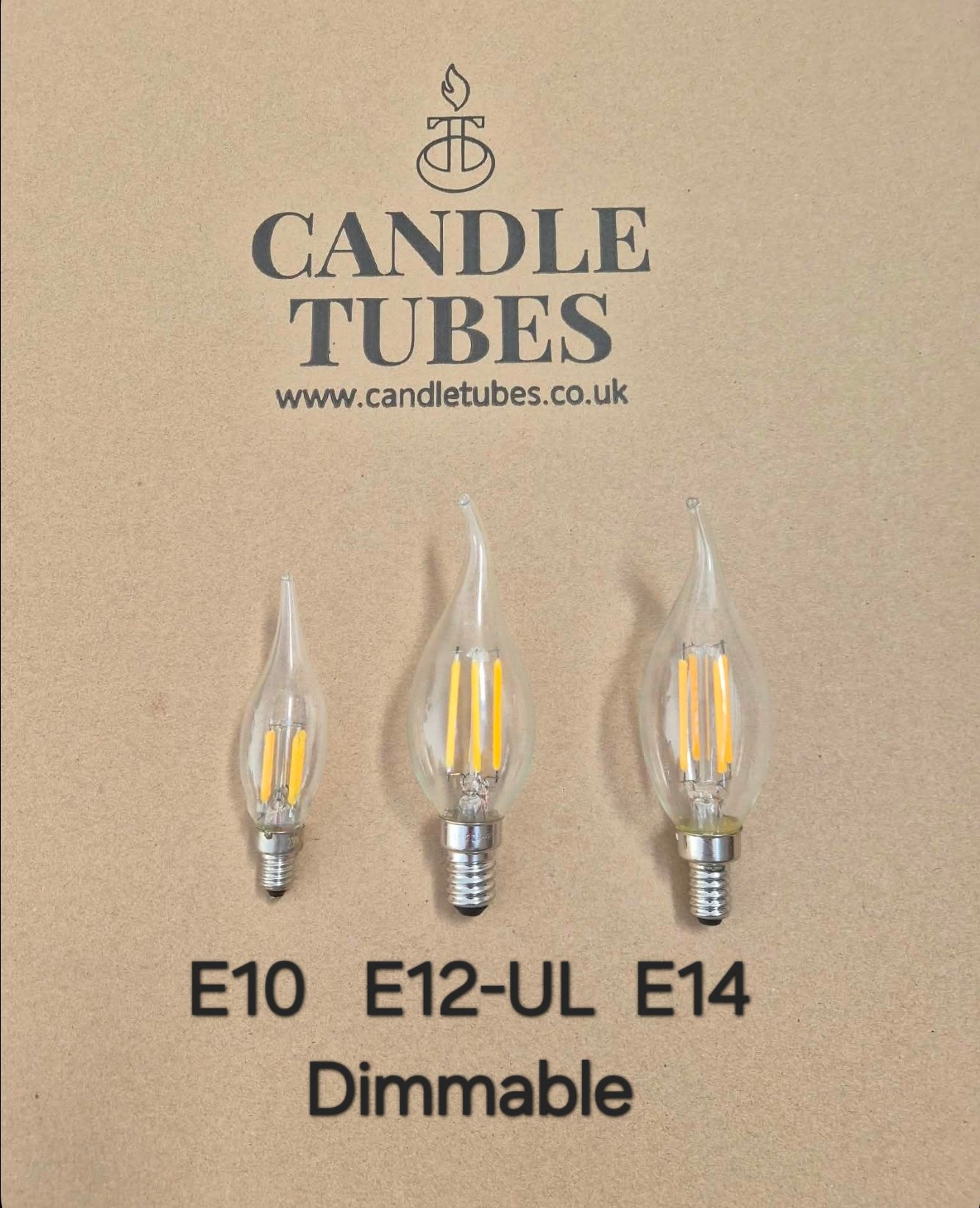
Our dimmable bulb range includes decorative flame-tipped options in three distinct base designations:
- E10 MES : E10 is the Miniature Edison Screw (MES) designation. It is the smallest of the three illustrated fittings.
- E12-UL : This is its own product designation and should not be treated as interchangeable with E10 or E14.
- E14 SES : E14 means Small Edison Screw (SES), commonly used in many European decorative lighting applications.
A common mistake is to identify a bulb by appearance alone. The correct choice depends on the lampholder fitted to your chandelier, the electrical specification and the available space inside the decorative tube or sleeve.
For the French GS Range, we recommend the E10 miniature MES flame-tipped bulb, subject to confirmation of the particular fitting and project specification. If you are unsure, send us the details or an original component and we can help you identify the appropriate decorative arrangement.
Could the dimmer be incompatible with your LED bulbs?
A bulb marked dimmable still requires a compatible dimmer. Older dimmers were often designed around incandescent or halogen lamps, and they may not operate correctly with modern LED candle bulbs.
Possible symptoms include:
- Flickering at low brightness.
- Sudden changes in light level.
- Uneven dimming between chandelier arms.
- Buzzing from the dimmer or fitting.
- A faint glow when the light is switched off.
- The chandelier working at full brightness but becoming unstable as you dim it.
There is no universal combination that works with every dimmer, bulb and chandelier. Compatibility depends on the specific products and the complete circuit. A qualified electrician can check the dimmer type, circuit condition and manufacturer guidance before recommending a replacement.
Do not assume that changing from one decorative bulb shape to another will solve the issue. Moving from an E14 bulb to an E10 bulb, for example, only helps if the chandelier has the correct matching E10 lampholders and the electrical arrangement has been designed for that fitting.
What should you check before replacing candle sleeves?
Candle tubes, candle sleeves and chandelier candle covers are often replaced when a chandelier is restored or redecorated. They can transform the appearance of a fitting, but they should be selected after confirming the electrical and physical arrangement.
Check the following:
- Bulb base: Is the fitting E10 MES, E12-UL or E14 SES?
- Lampholder: Does the existing lampholder match the selected bulb?
- Internal diameter: Can the candle tube slide over the required component without fouling it?
- Overall height: Will the flame-tipped bulb sit at the intended position?
- Clearance: Is there adequate space around the bulb, sleeve, shade and other decorative parts?
- Finish: Does the material and colour suit the chandelier, whether you require metal, card, glass or nylon?
- Electrical suitability: Has a qualified electrician confirmed that the bulb and dimmer are appropriate for the installation?

The candle tube should provide the visual illusion of a traditional candle, while allowing the bulb and lampholder to remain correctly positioned. It must not be forced into place or used to conceal damaged wiring, loose connections or unsuitable electrical components.
A practical chandelier flickering troubleshooting checklist
Work through this checklist methodically. It is not as complicated as it looks, but safety must come first.
-
Switch the chandelier off and allow it to cool.
Avoid handling bulbs or decorative tubes while they are hot. Watch for nasty pinches when removing tight sleeves or small decorative components. -
Confirm that every bulb is dimmable.
Do not mix dimmable and non-dimmable bulbs on the same dimmed chandelier. -
Check the bulb designations.
Confirm whether your installation uses E10 MES, E12-UL or E14 SES bulbs. Never rely on the apparent size of the glass envelope alone. -
Check whether all bulbs are the same type and model.
Mixing different LED drivers can produce inconsistent dimming, even when each bulb is individually marked dimmable. -
Test the chandelier at full brightness.
If it is stable at full brightness but flickers as the level is reduced, the dimmer and bulb combination may be incompatible. -
Look for dimmer information.
A qualified person can check whether the dimmer is rated for LED loads and whether its compatibility information matches the bulbs being used. -
Do not bypass, rewire or replace the dimmer unless competent and authorised to do so.
Electrical work should be handled by a qualified electrician. -
Note any additional warning signs.
Buzzing, burning smells, unusual heat, intermittent operation or flickering elsewhere in the property should be treated as reasons to stop using the fitting and arrange an electrical inspection. -
Only after the electrical arrangement is confirmed, specify the decorative components.
This is the point at which you can confidently select the appropriate candle tube, sleeve, cover, finish and height.
How do candle tubes affect the finished lighting result?
Although a candle tube does not repair electrical flicker, its dimensions and finish have a major influence on the appearance of your chandelier.
A tube that is too short may expose more of the lampholder than intended. One that is too tall may obstruct the flame-tipped bulb, interfere with shades or alter the proportions of the fitting. The internal fit is equally important: a decorative cover should not press against the bulb or prevent components from sitting naturally.
For restorers and lighting manufacturers, the most reliable approach is to measure the original part rather than guess from a photograph. Candle Tubes UK provides a digital measurement service: you can send us an original tube, sleeve or related component so we can assess the dimensions and help create a more accurate replacement.

We manufacture bespoke, made-to-order candle tubes for new designs and restoration replacements. Depending on the project, we can supply options in metal, card, glass or nylon, with finishes selected to complement the wider chandelier. Our specialist decorators and artists can also assist with custom finishing where a standard colour is not quite right.
Which bulb and candle tube combination should you choose?
Use this simple reckoner:
- Choose E10 MES when the chandelier has compatible E10 lampholders and the design calls for the smaller miniature fitting.
- Choose E12-UL only where the installation specifically requires that designation.
- Choose E14 SES where the chandelier is fitted with E14 SES lampholders.
- Select a bulb explicitly marked dimmable if the chandelier is controlled by a dimmer.
- Confirm the dimmer and circuit compatibility with a qualified electrician.
- Select the candle tube or sleeve only after checking bulb position, lampholder dimensions and clearance.
- For the French GS Range, consider our E10 miniature MES flame-tipped bulb recommendation, subject to checking the original component.

The right pairing should look coherent, fit neatly and support the intended lighting design. It should never be presented as a substitute for proper electrical assessment.
When should you call a qualified electrician?
Arrange an inspection before continuing to use the chandelier if:
- Flicker remains after fitting verified dimmable bulbs.
- Flicker occurs at full brightness as well as when dimmed.
- The dimmer is old, unmarked or not identified as LED-compatible.
- You hear buzzing, hissing or crackling.
- The switch, lampholders or chandelier become unusually warm.
- You notice a burnt smell or discolouration.
- Other lights in the property flicker.
- You are uncertain about the wiring, circuit or dimmer replacement.
A qualified electrician can assess the circuit, connections, dimmer and chandelier wiring. This is especially important for antique fittings, newly converted chandeliers and installations with many individual candle bulbs.
Need help choosing the right candle covers or bulbs?
We can help you separate the electrical questions from the decorative ones. Once the electrical installation has been checked, our team can advise on E10 MES, E12-UL and E14 SES decorative arrangements, bespoke candle tubes, candle sleeves and chandelier candle covers.
For guidance, contact Rachel’s office on 0330 113 7842 or visit:
With the correct dimmable flame-tipped bulbs, compatible dimmer and carefully measured decorative components, your chandelier can provide the smooth, welcoming glow it was designed to create ( with a finish that delivers the desired wow factor.)