In a hotel ballroom, restaurant or heritage property, a chandelier can be both a defining feature and a difficult maintenance job. If a routine bulb change means arranging access equipment, closing a room or bringing in a specialist contractor, even simple upkeep can become disruptive.
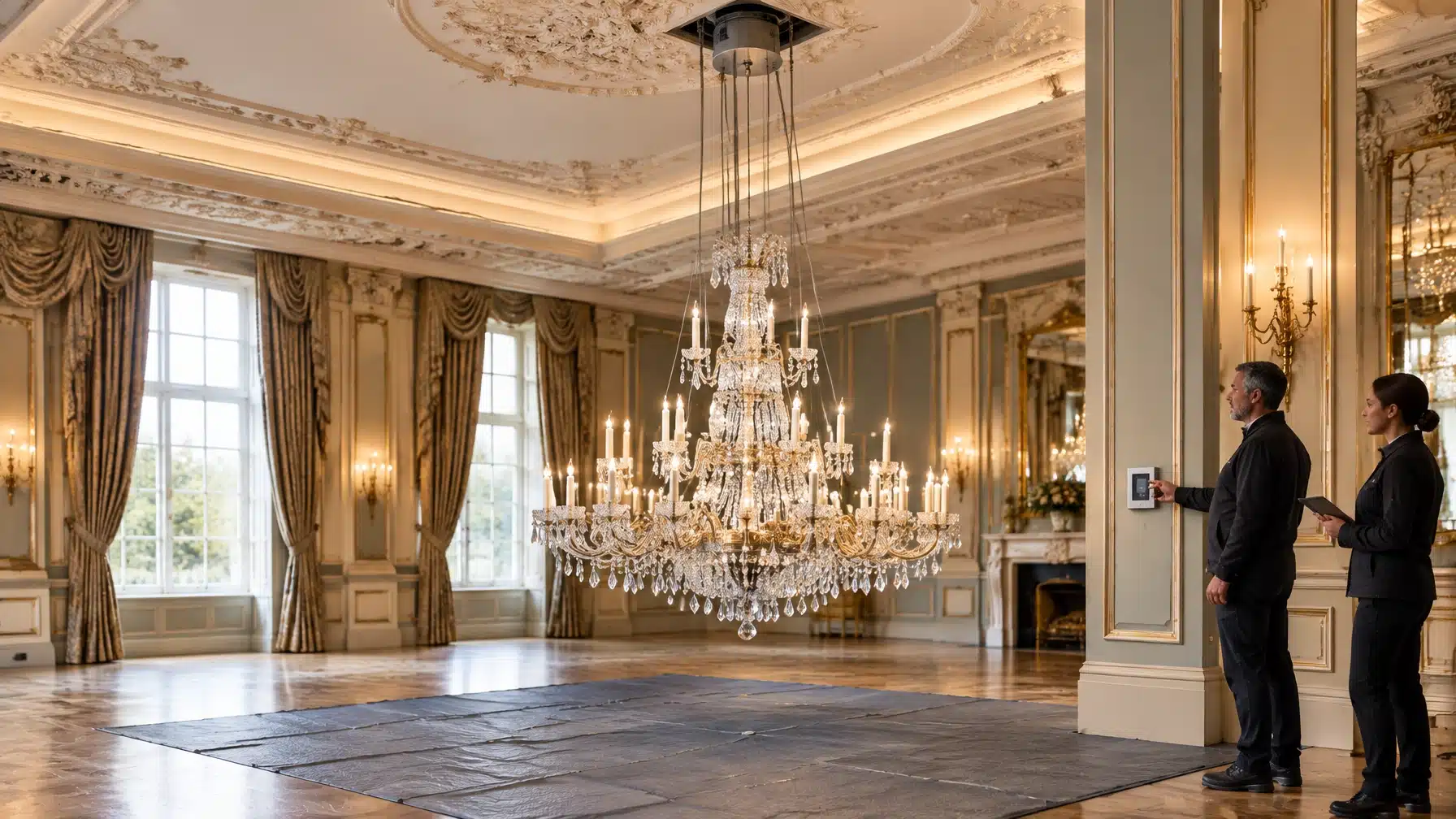
A chandelier hoist, also called a light lift or chandelier lift, offers another approach. Once properly specified and installed, it can lower a fitting to an accessible service position and return it to its original height. That can make planned maintenance easier to organise, with less interruption to daily operations.
Why is chandelier maintenance at height such a challenge?
Large chandeliers are often positioned above the safe reach of a ladder: in hotel lobbies, restaurants, stairwells, ballrooms, churches and listed buildings. Changing a bulb, cleaning crystal, inspecting candle sleeves or checking lampholders may require a tower, scaffold, contract lift or a room closure.
Those arrangements bring costs beyond the labour itself. Access equipment may need to be hired, contractors booked and public areas taken out of use. Moving equipment around a fragile fitting can also create a risk of accidental damage to crystal, decorative arms, surrounding finishes or historic plasterwork.
The result is that small maintenance tasks can be postponed until several have built up. A hoist can help turn those jobs into a planned routine, rather than a major access project each time. For general cleaning considerations, see our chandelier cleaning guide.

What is a chandelier hoist, and how does it work?
A chandelier hoist is a ceiling-mounted lowering system designed to move a suspended light fitting between its normal position and a lower working position. Depending on the system and project, the fitting may be lowered close to floor level or to another height where trained staff can reach it safely.
It is not simply a ceiling rose or hook plate. A rose or hook supports a fitting in one fixed position; a hoist is a lifting system designed to lower and raise it in a controlled way. The hoist and its fixing arrangement must be selected to suit the chandelier, the ceiling structure and the route of travel.
Two important considerations are:
- Load capacity: selected against the complete suspended fitting’s weight, with an appropriate working margin.
- Lowering height: the vertical travel needed to bring the chandelier to its planned maintenance position.
With a suitable system in place, routine tasks may be completed by one or two trained people in minutes rather than starting with a day of access-equipment planning. The specific process depends on the installation and the fixture.
How do you choose the right capacity and lowering height?
Light lifts are available in a range of capacities, typically from around 20kg to 250kg, with lowering heights often in the region of 5m to 10m. These are broad guide ranges, not a specification for any particular chandelier.
The correct unit depends on the individual fitting and site. A competent professional should confirm the weight to be lifted, the required travel and the suitability of the supporting structure before a system is chosen. Do not select a hoist based on the chandelier’s appearance or an estimate alone: the assessment should account for the complete suspended load and the system’s required working margin.
As a practical starting point, record:
- The chandelier’s confirmed weight and dimensions.
- The ceiling height and the height at which maintenance should take place.
- Available access to the ceiling void and the proposed fixing location.
- Any obstructions along the chandelier’s travel path.
A fitting does not always need to descend all the way to the floor. The aim is to bring it to a position that is accessible and appropriate for the intended work. Final capacity, fixing and travel requirements must be confirmed for each project.
Why can a chandelier hoist pay for itself?
A hoist is an investment in the way a property manages lighting maintenance. Its value is not only in lifting the chandelier; it can also reduce the amount of planning and disruption involved in routine work.
Potential operational benefits include:
- Fewer repeat access-equipment costs for routine maintenance tasks.
- Quicker bulb and candle sleeve changes, with less disruption to room bookings.
- More practical in-house cleaning and inspection, where staff are trained and the task is appropriate.
- Reduced handling around fragile arms and crystal, compared with arranging access around the fitting.
- Easier planned maintenance, because inspections and small replacements are more straightforward to schedule.
- Less risk of marking ceilings or decorative plasterwork with repeated access equipment.
Actual savings depend on how often the chandelier needs attention, the room’s use and the access costs at the property. For busy hospitality venues, making servicing easier to plan can be just as valuable as reducing the direct cost of each visit.
What does a lowered chandelier mean for sleeves and lampholders?
When a chandelier is at a comfortable working height, it is much easier to identify the small details that are difficult to inspect overhead. You can compare candle sleeves, candle covers and candle tubes against the fitting, check their dimensions and finishes, and look for cracked or discoloured components. You can also spot a leaning lampholder or a finish that has become tired over time.
Candle Tubes UK supplies restoration lighting parts and made-to-order components for new fittings and existing chandeliers. Our ranges include products for E10 (MES), E12-UL and E14 (SES) applications. The right component depends on the fitting and its measurements; the cap code alone does not determine the correct sleeve size.
Where an original component is available, our digital measurement service allows you to send it to us for accurate assessment. We also offer bespoke manufacturing and work with a collective of specialist decorators and artists for custom finishes.

A hoist makes components easier to reach, but it does not itself alter the electrical installation. Electrical work, including any changes or repairs, should be carried out by a qualified electrician. For measurement guidance, see our article on avoiding candle tube measurement pitfalls.
Can you plan installation into a new project?
Yes. A hoist can be considered at the outset of a new-build, refurbishment or lighting project, before the chandelier is hung. Early planning gives the project team the opportunity to assess the ceiling structure, required access and electrical supply, rather than trying to accommodate those elements after the fitting is in place.
Candle Tubes UK offers a professional hoist fitting service. Every installation should be assessed on site by a competent professional, because the work reaches into the ceiling structure and electrical supply. The building’s structure and the electrical arrangements need to be reviewed by suitably qualified professionals for the specific site.
What should hospitality and facilities buyers confirm?
Before commissioning a chandelier hoist, use this checklist to organise the key project information:
- Fixture weight: has the complete suspended load been confirmed?
- Ceiling and travel: what is the ceiling height, and what lowering height is needed for maintenance?
- Ceiling void: is there suitable access and enough space for the planned equipment?
- Structural fixing: has the proposed support point been assessed by a competent professional?
- Load margin: has the hoist been selected for the confirmed load, with an appropriate working margin?
- Electrical safety: have isolation, electrical work and testing been planned with a qualified electrician?
- Maintenance routine: who will operate the system, and how will subsequent cleaning and maintenance be managed?
These checks are a useful starting point, not a substitute for a project-specific assessment.
Frequently asked questions
What is a chandelier hoist?
It is a ceiling-mounted lifting system that lowers a chandelier to an accessible service position and raises it back into place. It is also commonly called a light lift or chandelier lowering system.
Can any chandelier be fitted with one?
Not automatically. The chandelier’s weight and design, the ceiling structure, available space and electrical arrangements all need to be assessed for the individual project.
How much weight can a light lift take?
Typical capacities span roughly 20kg to 250kg, but this is a broad range across systems. A competent professional must confirm the right capacity for the complete fitting and its installation.
How far can a chandelier hoist lower a fitting?
Lowering heights are typically around 5m to 10m, depending on the system. The required travel should be established from the installed position to the intended maintenance height.
Do I still need an electrician?
Yes, for electrical work, changes or repairs. A hoist does not change the chandelier’s electrical installation, and electrical work should be carried out by a qualified electrician.
Can you fit it for us?
We offer a professional hoist fitting service. Contact Rachel’s office on 0330 113 7842 to discuss your project and arrange an on-site assessment.
For bespoke candle sleeves, candle covers, candle tubes and restoration components, visit www.candletubes.co.uk, www.candletubes.com or www.candletubes.eu.