If you have ever stood atop a ladder, balancing precariously while trying to measure the diameter of a dusty chandelier socket, you are not alone. It is a common scene in the world of restoration and interior design. Whether you are a professional restorer breathing life into a French antique or a DIY enthusiast giving your dining room a bit of a "wow" factor, the world of socket sizes: E10, E12, and E14: can feel like a bit of a minefield.
At Candle Tubes UK, we believe that understanding your fixtures shouldn't feel like a chore. It is, in fact, quite straightforward once you know what you are looking for. As the UK's leading manufacturer of bespoke candle tubes (sometimes called candle sleeves or candle covers), we have seen it all. From the lavish grand ballrooms of Europe to the contemporary apartments of New York, getting the right fit is the difference between a lighting fixture that looks "nearly right" and one that looks truly spectacular.
In this guide, we’ll break down the technicalities of the "big three" global standards and help you choose the perfect material: be it nylon, card, metal, or glass: to finish your project with style.
What Do the Numbers Actually Mean?
Before we dive into the specific styles, it is prudent to understand the "E" nomenclature. Named after Thomas Edison (the "E"), the number following it refers to the diameter of the screw base in millimetres.
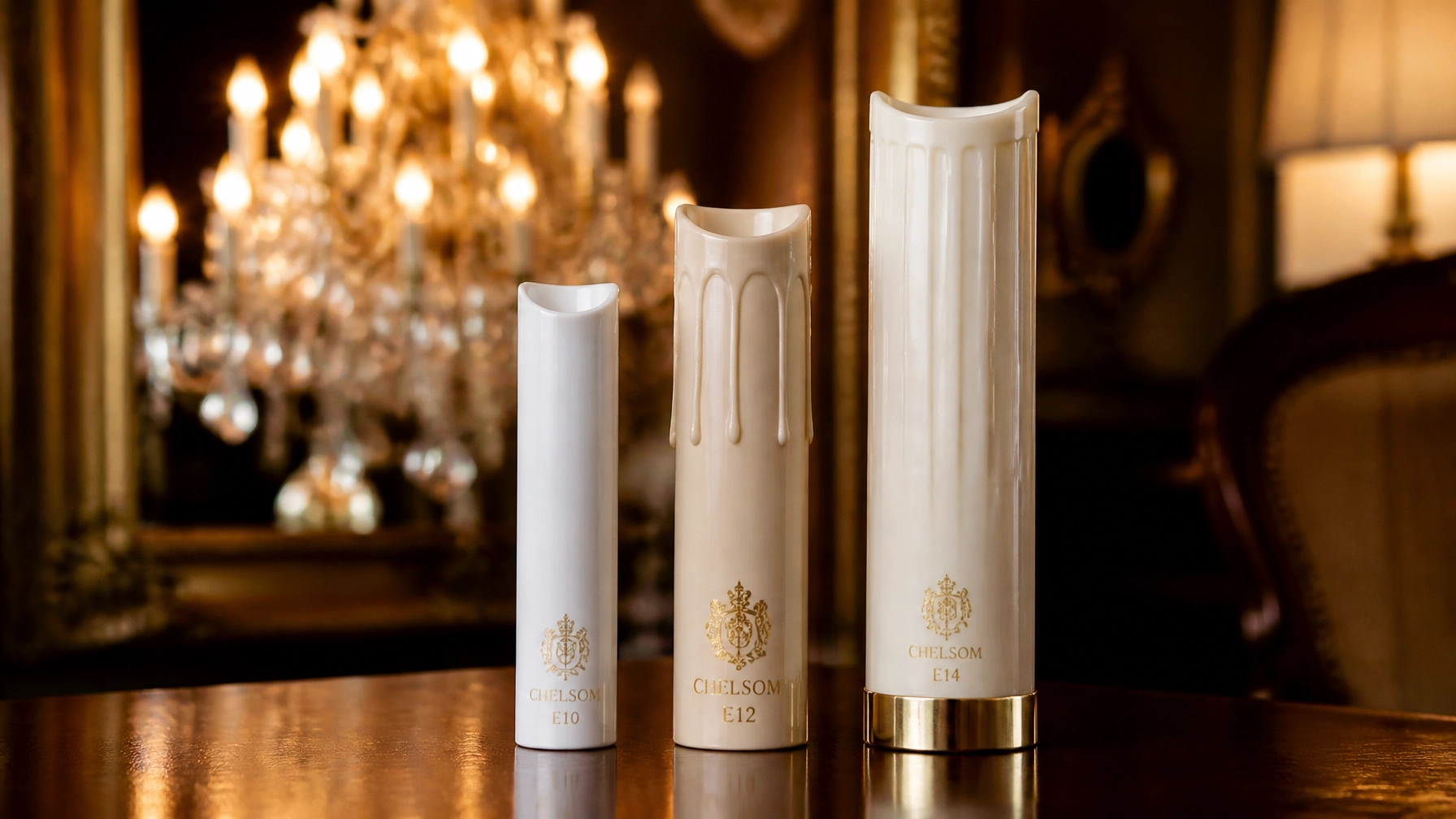
- E10: 10mm diameter (Miniature Edison Screw / MES)
- E12: 12mm diameter (Candelabra Edison Screw / CES)
- E14: 14mm diameter (Small Edison Screw / SES)
While a few millimetres might seem negligible, in the world of lighting, they are worlds apart. An E12 bulb simply won’t fit into an E14 socket: and even if you force the issue, you’re looking at a potential electrical safety hazard or a "nasty pinch" to your wiring. (Always ensure the power is off at the mains before you start tinkering, of course!)
E10: The French GS (Grand Siècle) Style
The E10 is the "dainty" member of the family. Often referred to in the trade as the French GS (Grand Siècle) style, these are typically found on very fine, delicate French chandeliers and wall sconces.
Because the base is only 10mm wide, the candle tubes for these fittings are remarkably slim. This allows them to sit elegantly on narrow crystal arms without looking bulky or out of proportion. If you are lucky enough to have an authentic French antique, you will likely find these tiny, pointed-tip bulbs (often 7W or low-wattage LEDs) peeking out from very thin sleeves.
- Best for: Delicate French antiques, narrow-arm crystal chandeliers, and niche restorations.
- Our recommendation: Our bespoke nylon or card sleeves can be bored to these exact miniature specifications for a flush, seamless look.
E12: The UL/American Standard
If you are sourcing a chandelier from North America, or working on a project for a client across the pond, you will encounter the E12. This is the standard "Candelabra" base in the United States and Canada (often part of UL-listed fixtures).
The E12 sits right in the middle of the pack. It is slightly more substantial than the E10 but doesn't have the "heft" of the European E14. On many American traditional brass or iron chandeliers, the E12 provides that classic "candle" silhouette that we all know and love.

- Best for: US imports, American-style traditional lighting, and mid-sized fixtures.
- Top Tip: If you've bought a stunning light from the US, remember the voltage is different (120V vs the UK's 230V). You'll need to ensure your E12 bulbs are rated for the UK/EU voltage, even if the socket is American!
E14: The English Regency & European Standard
The E14, or Small Edison Screw (SES), is the undisputed king of the UK and European lighting market. Our English Regency range is specifically designed around this standard.
The E14 allows for a more formal, stately aesthetic. Because the socket is 14mm wide, the candle tubes have a larger internal diameter (often around 23mm to 30mm external diameter). This provides enough surface area for us to create our prestigious "tapered" look: where the base of the tube is slightly wider than the top, mimicking the way a real wax candle narrows as it burns.
- Best for: UK and European chandeliers, neoclassical designs, and high-ceilinged rooms where a bolder visual presence is required.
- Proportions: For those with high ceilings (lucky you!), the E14 standard allows for much taller candle tubes (up to 500mm) without the tube looking like a "straw."
The Materials: From Card to Glass
Once you’ve identified your socket size (E10, E12, or E14), the fun part begins: choosing the finish. This is where you can truly customise the look of your room.
1. Cardboard (The Classic Choice)
Don't be fooled by the name; our professional-grade card sleeves are far from "basic." They come in various shades of cream and white, and we can even provide them with a "waxed drip" effect for that authentic, lived-in feel. (Perfect for country manors or rustic kitchens!)
2. Nylon (The Prestigious Taper)
Our English Regency and American Regency ranges are crafted from pure Nylon. It is incredibly durable, heat-resistant, and has a smooth, semi-matte finish that looks remarkably like real wax. These can be bespoke-made to include a taper, which adds a refined, neoclassical balance to any fixture.
3. Metal (Modern & Lavish)
For those seeking a contemporary edge or a "lavish" look, our metal range is the way to go. From highly polished gold and chrome to antique copper and bronze, metal sleeves offer a clean, reflective surface that works brilliantly with modern LED flame-tip bulbs.

4. Glass and Quartz
Our most prestigious range involves Glass and Quartz sleeves. These are translucent and catch the light beautifully, creating a "glow" from within when the light is switched on. They are the pinnacle of bespoke lighting design.
Measuring Up: Our Digital Measurement Service
We know that measuring old candle covers can be a "reckoner" of a task. Maybe the old ones are warped, or maybe you only have a broken fragment to work with.
It’s not as complicated as it looks.
To take the guesswork out of the process, we offer a specialised Digital Measurement Service. You don't need to be a technical drafter to get it right. Simply send us a high-quality photograph of your original part next to a ruler, or better yet, pop the original part in the post to us at our Corby headquarters.

Our team will use digital calipers to measure the internal diameter (to ensure it fits over your lampholder) and the outer diameter (to ensure it fits your bobeche or "drip pan"). We then manufacture your bespoke tubes to those exact specifications. It’s a "perfect fit" guarantee that saves you the headache of returns and resizing.
Why the Height of Your Candle Tube Matters
When perusing our catalogue, you’ll notice we offer various lengths. Why does height matter?
- Glare Prevention: A tube that is too short will expose the ugly plastic or metal of the lampholder.
- Eye-line Obstruction: On a dining room chandelier, you want the "flame" to be above or below the eye level of your guests to avoid distraction.
- Proportion: As a rule of thumb, the candle tube should generally be about 2.5 to 3 times the height of the bobeche (the little saucer at the bottom) to look balanced.
Safety First: A Note on Heat
Whether you are using an E10, E12, or E14 socket, you must consider the heat generated by the bulb. Traditional incandescent bulbs get very hot, which can discolour card sleeves over time.
Top Tip: We always recommend switching to high-quality LED flame-tip bulbs. Not only are they more energy-efficient, but they also run cool, ensuring your bespoke nylon or card sleeves stay looking "brand new" for years to come.

Ready to Elevate Your Lighting?
Choosing between E10, E12, and E14 doesn't have to be a daunting task. By matching your socket size to the correct regional standard and selecting a material that suits your décor, you can transform a standard light fitting into a bespoke masterpiece.
Whether you need a single replacement for a cherished family heirloom or a full set for a new interior design project, we are here to help. Our bespoke, made-to-order service ensures that no matter how unique your fixture is, we can create the perfect cover for it.
Peruse our full range and start your restoration journey today:
- www.candletubes.co.uk (UK)
- www.candletubes.com (USA & Global)
- www.candletubes.eu (Europe)
If you’re still unsure which "E" you need, don’t hesitate to reach out. We’ve been the UK’s leading manufacturer for years, and we’d be delighted to share our "insider knowledge" to help you get it just right.