There is an undeniable allure to a grand chandelier. Whether it is a sprawling crystal masterpiece in a hotel foyer or a bespoke metal fixture in a high-ceilinged Victorian hallway, these pieces are the "wow" factor of any room. However, for many homeowners and building managers, that initial awe eventually turns into a somewhat daunting question: “How on earth are we going to clean that?”
If you are lucky enough to have high ceilings, you already know the struggle. Dust settles, spiders find new real estate, and light bulbs, as if by some cosmic conspiracy, always seem to flicker out just as you’ve finally put the ladder back in the garage. For years, the only solution was to hire expensive scaffolding or risk a "nasty pinch" (or worse) balancing on a precarious A-frame.
Enter the chandelier hoist. At Candle Tubes UK, we’ve spent years working with lighting designers and restoration specialists, and we can confidently say that a motorized hoist is the single most prudent investment you can make for your lighting fixtures. It’s not just a luxury; it’s a masterclass in easy maintenance.
What Exactly is a Chandelier Hoist?
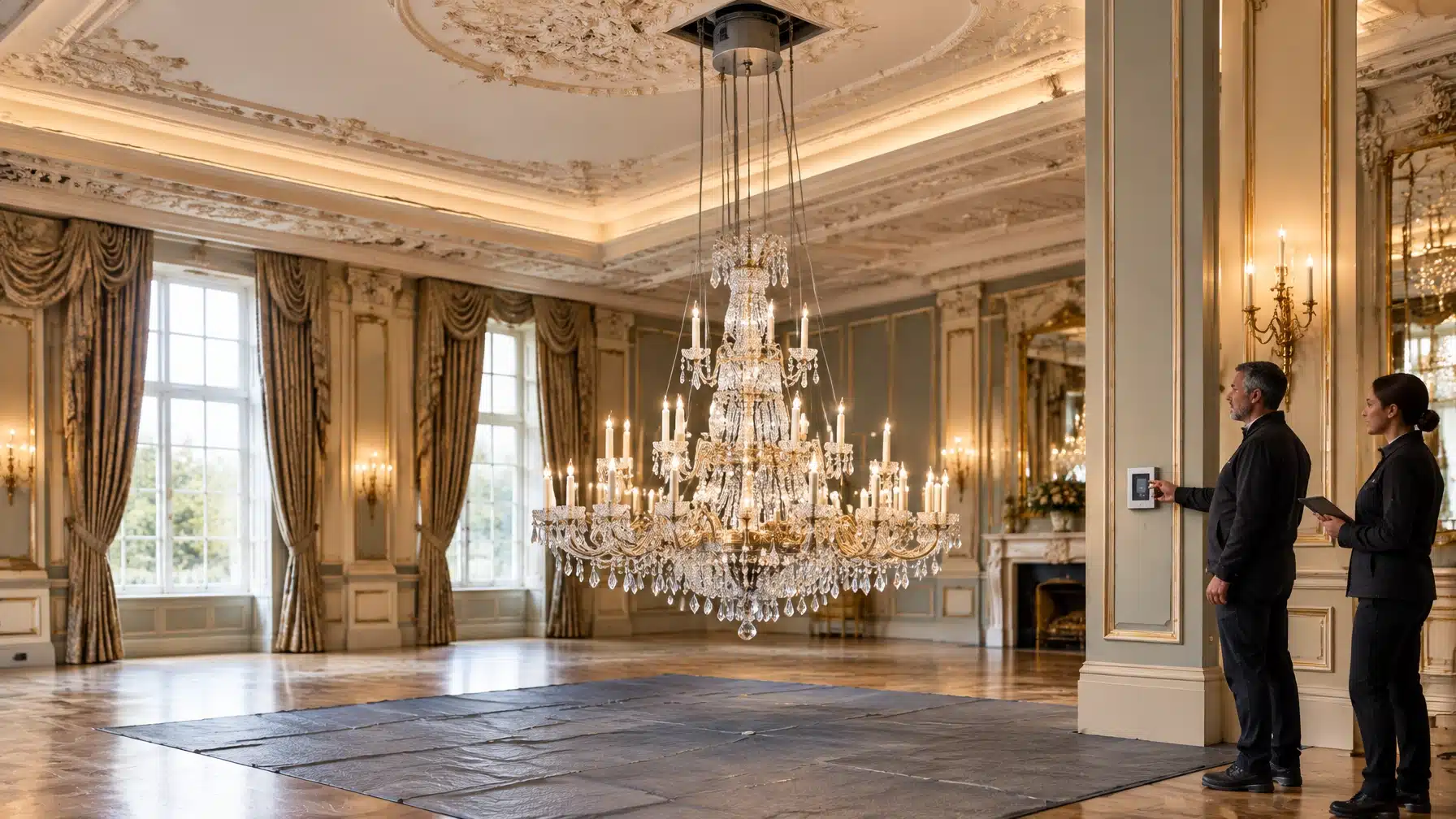
In its simplest form, a chandelier hoist (also known as a lighting winch or lift) is a motorized mechanical system installed discreetly within your ceiling or attic space. With the turn of a key or the press of a button on a remote control, the entire chandelier is lowered safely to floor level.
Once the fixture is at a comfortable working height, you can perform routine maintenance without ever leaving the ground. When you’re finished, the hoist raises the chandelier back to its original position, locking it securely into place. It’s a seamless process that turns a weekend-long chore into a twenty-minute task.

Is it Really Safer Than a Ladder?
In a word: Yes. Working at height is one of the leading causes of accidents in both domestic and commercial environments. When you are dealing with a heavy, multi-arm chandelier, the risks are magnified.
Why a hoist is the safer choice:
- Eliminates "The Lean": We’ve all been there: reaching just a little bit further on the ladder to clean that last crystal. A hoist brings the work to you, ensuring you remain firmly on terra firma.
- Automatic Power Disconnect: Most high-quality hoists (including the types we recommend to our professional clients) feature an integrated power disconnect. As the chandelier is lowered, the electrical contact plates separate, cutting the power to the fixture. This minimizes the risk of electric shock or short circuits while you are wiping down metal components or changing bulbs.
- Dual Locking Systems: A common worry is, "What if the cable snaps?" Modern hoists are designed with redundant safety mechanisms. They often feature dual independent locks that hold the load when raised, guarding against mechanical failure.
- Restricted Access: Most systems utilize a keyed wall switch. This ensures that the chandelier can only be moved by a designated person, preventing curious hands from accidentally operating the lift.
Why High Ceilings Demand a High-Tech Solution
Whether you are managing a boutique hotel, a village hall, or a lavish private residence, high ceilings present a unique set of challenges. In spaces where the ceiling exceeds 15 or 20 feet (about 6 metres), the cost of "temporary access" (renting scaffolding or a cherry picker) can quickly outweigh the cost of a permanent hoist.
If you peruse our digital measurement service at www.candletubes.co.uk, you’ll see that we often deal with very specific, bespoke requirements. The same applies to hoists. They are designed to be discreet, often hidden behind an ornamental ceiling rose, so the only thing people see is your stunning light fixture: not the machinery behind it.
The Perfect Time for a "Bespoke" Refresh
One of the greatest benefits of lowering your chandelier to floor level is the ability to give it a truly thorough inspection. This is the perfect time to look at the finer details that you might miss from 10 feet below.
Are your candle tubes looking a bit worse for wear? Over time, heat from traditional bulbs can discolour card sleeves, and dust can dull the finish of metal or glass tubes. While the chandelier is lowered, you can easily slide off old, yellowed covers and replace them with our premium range of Nylon, Metal, or even prestigious Quartz sleeves.

A Rule of Thumb for Maintenance
We usually recommend a "Deep Clean & Component Check" once a year for residential fixtures and twice a year for commercial settings like restaurants or hotel lobbies where dust and grease accumulate faster.
While the fixture is down, check for:
- Bulb Health: Replace any flickering bulbs. We highly recommend our Flame-tip LED candle bulbs (usually E14 or SES cap codes) for that classic look with modern longevity.
- Sleeve Alignment: Ensure your candle tubes are sitting flush. If they look crooked, it might be time for new fixing brackets.
- Cable Integrity: Check the main support cable and the electrical wiring for any signs of fraying or heat damage.
How to Choose the Right Hoist: A Quick Reckoner
Choosing a hoist isn't as complicated as it looks, but you do need to be precise with your measurements. Here are the three main factors to consider:
- The Weight Limit: You must know the total weight of your chandelier, including all glass, bulbs, and sleeves. Most hoists are rated in categories (e.g., 50kg, 100kg, 250kg). Always choose a hoist with a capacity that exceeds your fixture's weight by at least 20% for a "prudent" safety margin.
- The Vertical Travel: How high is your ceiling? You need to ensure the hoist cable is long enough to reach all the way to the floor (or to a height where you can comfortably work from a small step-stool).
- Electrical Requirements: Most hoists require a standard 230V supply. Some modern systems can even be integrated into a smart home setup, allowing you to lower the lights via an app: a perfect companion to our Smart WiFi range.
The Aesthetic Result: Form Meets Function
Some worry that installing a mechanical lift will ruin the "lines" of a beautiful room. On the contrary, when installed correctly, the hoist is invisible. The result is a chandelier that always looks its best because the "barrier to entry" for cleaning has been removed.
Imagine a dining room where the light reflects perfectly off every single crystal because they aren't coated in a year's worth of dust. That is the true value of a hoist.

Final Thoughts: A Wise Investment in Longevity
At Candle Tubes UK, we believe that beautiful lighting should be enjoyed, not dreaded. A chandelier hoist is more than just a convenience; it’s a safety feature and a preservation tool. It protects your expensive fixture from accidental damage during manual handling and ensures that you can keep it in pristine condition for decades to come.
Whether you are looking for a bespoke quartz sleeve to finish off your restoration or you're just starting to plan your high-ceiling lighting layout, remember that maintenance is part of the design process. Don't let your beautiful chandelier become a "dust magnet" simply because it's out of reach.
For more information on bespoke components or to chat about your next restoration project, feel free to peruse our full range at www.candletubes.co.uk, www.candletubes.com, or www.candletubes.eu. We’re here to help you keep things looking brilliant, from the ceiling right down to the floor.