When you are restoring a chandelier or designing a new decorative light, the E14 lamp holder is one of the small components that makes a considerable difference. It determines which bulb will fit, how the candle tube is supported and, ultimately, whether the finished fitting looks refined rather than improvised.
The good news is that it is not as complicated as it looks. An E14 dimmable flame-tipped bulb can be used with a compatible E14 lampholder because both use the same E14 / SES fitting (Small Edison Screw). However, the fitting must be checked carefully: the bulb must be marked dimmable, and the installed dimmer and circuit must also be suitable.
At Candle Tubes UK, we manufacture bespoke components for chandeliers, lamps and restoration projects, including E14 lampholders, candle tubes, candle sleeves and chandelier candle covers.
What is an E14 lamp holder?
An E14 lamp holder is the electrical socket into which an E14 bulb screws. The term “E14” refers to the fitting size, while “SES” is the commonly used alternative term for Small Edison Screw.
The E14 fitting is widely used in decorative lighting, including:
- Traditional chandeliers
- Wall lights and sconces
- Table and floor lamps
- Period restoration projects
- Bespoke lighting designed by manufacturers and interior designers
The shape of the bulb is not what determines compatibility. A candle-shaped, flame-tipped or decorative bulb can be suitable provided that its base is marked E14 / SES and the electrical specifications match the fitting.
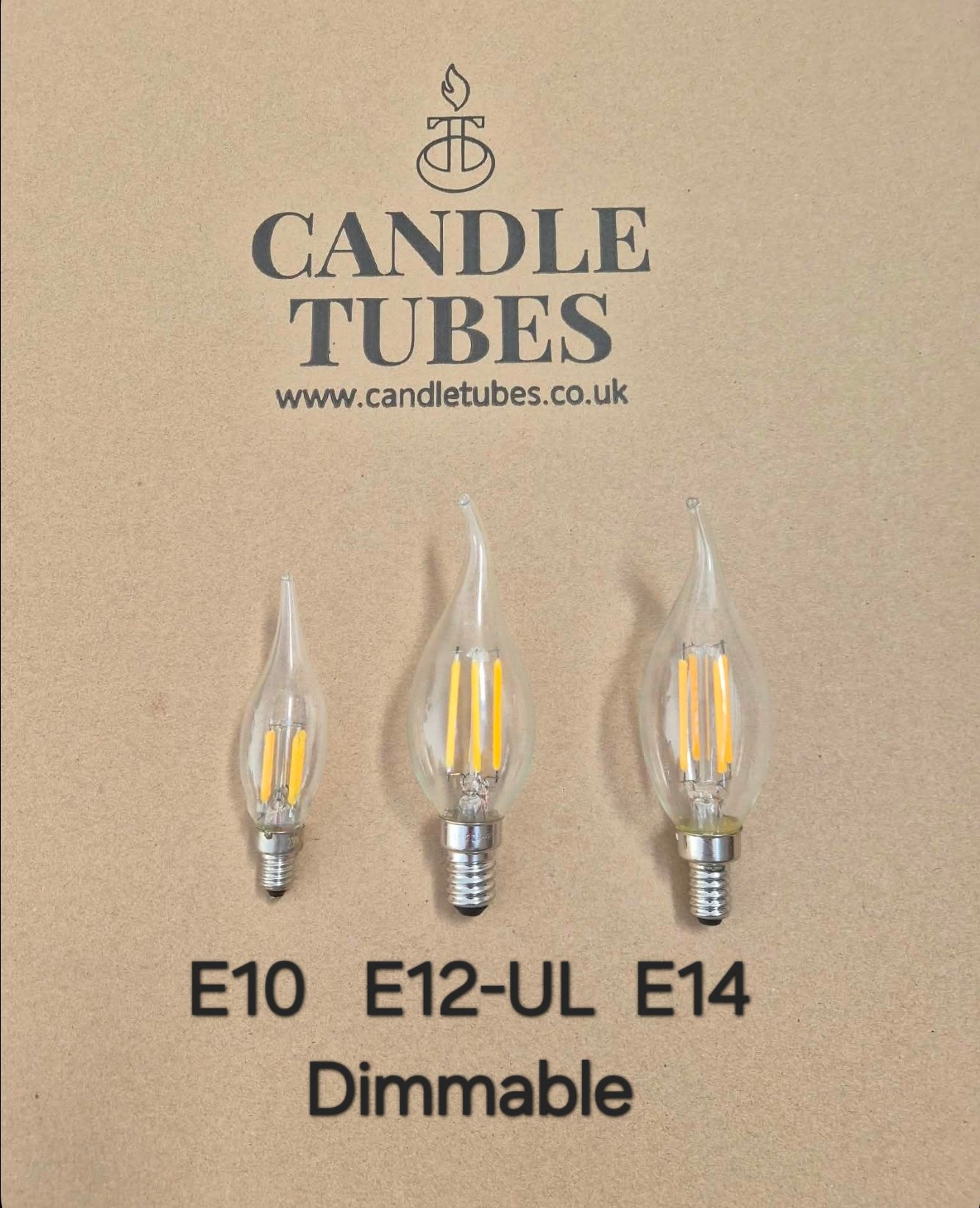
It is prudent not to confuse E14 with E10, E12-UL or other small screw fittings. They may look similar at a glance, but they are different sizes and should not be treated as interchangeable.
Can you use an E14 dimmable flame-tipped bulb with an E14 lampholder?
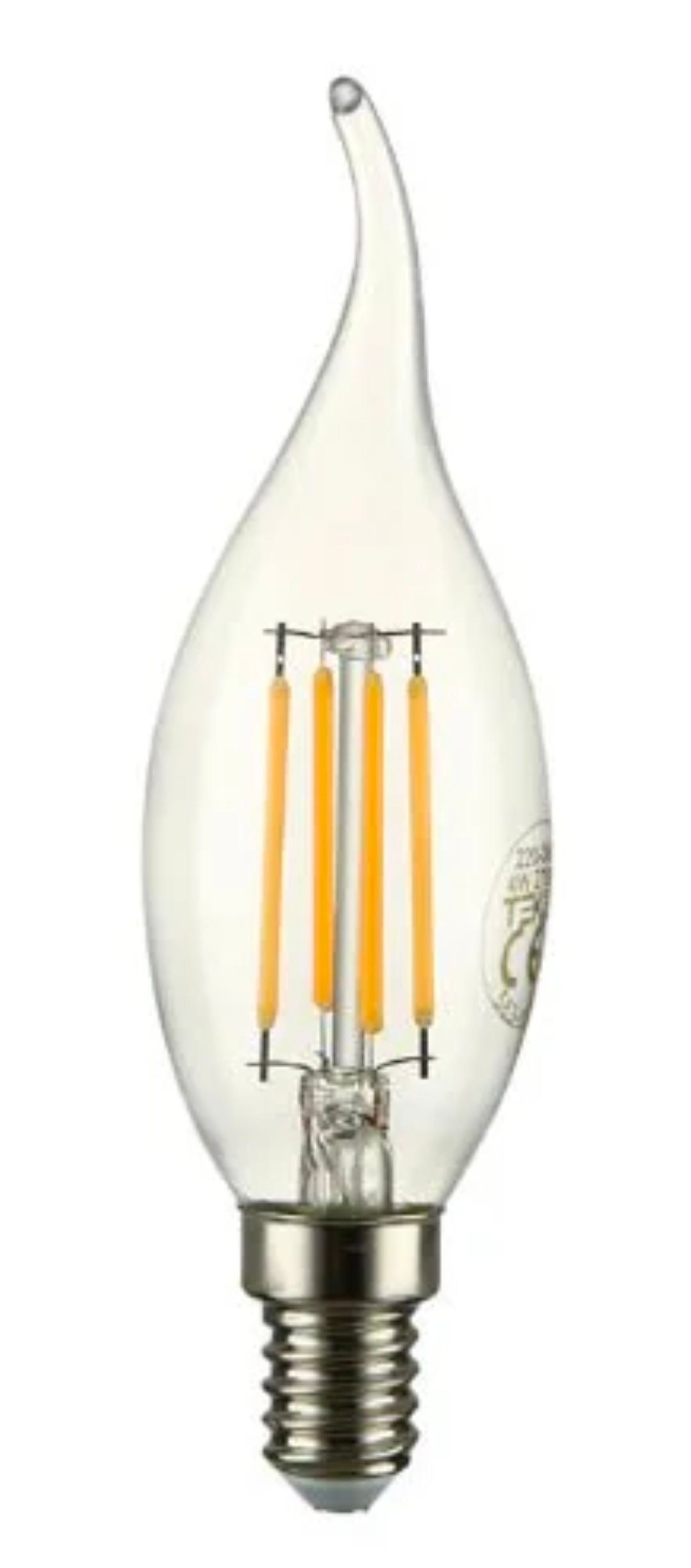
Yes, an E14 dimmable flame-tipped bulb is designed to screw into a compatible E14 lampholder.
The key points are:
- The bulb must have an E14 / SES base.
- The bulb must be clearly marked dimmable if you want to use a dimmer.
- The dimmer must be compatible with the bulb and its technology.
- The circuit and installation must be checked by a qualified electrician.
- The bulb’s voltage and other ratings must match the fitting and supply.
- The bulb must not exceed the permitted rating of the lampholder or complete light fitting.
- There must be adequate clearance and ventilation within the candle tube or cover.
The E14 socket itself does not make a bulb dimmable. Dimming depends on the bulb, the dimmer and the wider circuit working together. If an incompatible dimmer is used, symptoms can include flickering, poor dimming performance or the bulb failing to operate as expected.

The comparison above shows three dimmable options: E10, E12-UL and E14. For an E14 chandelier fitting, select the E14 version, not simply the bulb that looks closest in size.
Which E14 lampholder sizes are available?
Our E14 lampholder range has a 22.5mm diameter and is available in several height configurations to suit different chandelier arms, candle sleeves and restoration requirements.
Fixed E14 lamp holders: 65mm, 85mm and 100mm
Fixed-height options are available at:
- 65mm
- 85mm
- 100mm
These are useful when the original design has a known, consistent dimension across each arm. They can also provide a neat solution for new chandelier production where the designer already has a set measurement.
The correct height helps position the candle tube and bulb consistently. Too short, and the candle appearance may look compressed. Too tall, and the bulb or sleeve may sit higher than intended, changing the proportions of the chandelier.
Adjustable E14 lampholders: 80–100mm and 100–120mm
Adjustable bracket options are available at:
- 80–100mm
- 100–120mm
These are especially helpful for restoration work, where original components may have warped, been replaced or no longer be available. They also give lighting manufacturers and restorers additional flexibility when matching an existing arm or decorative cover.
Adjustability should not be used as a substitute for accurate measurement. It is still essential to check the original part, the available space and the desired finished height before ordering.
Earthing terminals and finish options
All of our E14 lampholders are supplied with earthing terminals. Electrical connections and earthing must be installed and tested correctly by a qualified electrician.
Black and white options are available where supported within the range. If colour consistency is important, particularly across a visible restoration, please confirm the required finish when enquiring.
How do E14 lampholders work with candle tubes and sleeves?
The lampholder provides the electrical connection and supports the bulb. The candle tube, candle sleeve or candle cover then disguises the technical components and creates the appearance of a traditional candle.
A typical arrangement consists of:
- The chandelier arm or lamp structure.
- The E14 lampholder fixed securely to the arm.
- The candle tube or sleeve positioned around the lampholder.
- The E14 flame-tipped bulb screwed into the holder.
- Any suitable decorative cover or wax-effect detail added to complete the appearance.
This combination allows you to retain the character of a traditional chandelier while using a modern decorative bulb. The flame-tipped profile draws the eye upwards, while the candle sleeve conceals the holder and supports the overall period appearance.
For a classic finish, the diameter and height of the tube should be proportionate to the chandelier arm and bulb. A carefully matched set produces the “wow” factor that is often missing when generic replacement parts are used.
Our Nylon French Candles and French GS Range can be considered alongside other bespoke candle tube solutions, but always check the original bulb cap and lampholder before selecting a replacement. Different ranges may use different fittings, so an E10 solution should not be substituted for an E14 arrangement without confirmation.

How do you choose the correct E14 lamp holder height?
The most reliable approach is to measure the original component rather than estimate from photographs.
As a useful starting point, record:
- The outside diameter of the existing lampholder or sleeve.
- The total height of the original holder.
- The distance from the chandelier arm to the top of the candle tube.
- The amount of bulb that should remain visible.
- The internal diameter and depth of the candle cover.
- The position of the wiring and earth connection.
- Whether the original holder was fixed or adjustable.
A rule of thumb is to compare the complete assembly, not just the holder. A 65mm holder may be right for one chandelier arm but too short for another once the candle sleeve and decorative details are taken into account.
If you have the original part, our digital measurement service can help remove the guesswork. You can send us an original component, and we can use it to establish the required dimensions for a made-to-order replacement. This is particularly useful for unusual, discontinued or damaged fittings.
What safety checks should be made before fitting an E14 bulb?
Electrical work should be undertaken by a qualified electrician. Before any work begins, the circuit must be isolated and proved dead using appropriate procedures.
Important checks include:
- Confirm that the bulb is E14 / SES.
- Check the bulb’s stated voltage against the intended supply.
- Check the lampholder and light fitting’s permitted rating.
- Confirm that the bulb is marked dimmable if a dimmer is being used.
- Confirm that the dimmer is compatible with the bulb.
- Check that the bulb does not foul the candle tube, sleeve or cover.
- Ensure that heat can dissipate appropriately.
- Inspect wiring, terminals and earthing arrangements.
- Do not force a bulb into a holder or overtighten it (a nasty pinch or damaged thread is easily avoided).
- Replace damaged holders, cracked insulation or compromised wiring before use.
A qualified electrician should make the final compatibility assessment, particularly for antique chandeliers, rewired fittings and installations with multiple bulbs or specialist control systems.
Why choose bespoke E14 lamp holders and chandelier candle covers?
Off-the-shelf components can be suitable for straightforward replacements, but they may not match the dimensions, finish or proportions of a valuable chandelier.
Our made-to-order service is useful when you need:
- A specific fixed height
- An adjustable bracket
- A particular diameter
- A black or white option where supported
- A replacement for a discontinued component
- A consistent result across multiple chandelier arms
- Candle tubes, sleeves or covers made to complement the holder
- Restoration parts based on an original sample
We work with lighting manufacturers, retailers, professional restorers, interior designers and homeowners. Whether you are refurbishing one cherished fitting or specifying components for a larger production run, accurate measurement is the prudent way to achieve a reliable result.

Our recommended bulb pairing for an E14 chandelier
For an E14 lampholder, we recommend our E14 dimmable flame-tipped bulb, provided that the bulb, dimmer and circuit are compatible. Its decorative flame profile works brilliantly with candle tubes, candle sleeves and chandelier candle covers, helping you achieve a traditional candlelit appearance while retaining control over the light level.
If you are unsure whether your existing fitting requires E10, E12-UL or E14, do not rely on appearance alone. Send us the original component or contact our team for guidance.
To discuss E14 lamp holders, bespoke candle covers or digital measurement, contact Rachel’s office on 0330 113 7842.
You can also peruse our services for customers worldwide at:
Frequently asked questions about E14 lamp holders
Is an E14 lamp holder the same as an SES lampholder?
Yes. E14 is the fitting designation, while SES means Small Edison Screw. Both terms describe the same general screw-fitting size.
Will any E14 bulb fit an E14 lampholder?
The bulb should physically screw into the holder if both are E14 / SES, but that does not guarantee complete compatibility. You must also check voltage, rating, dimensions, enclosure clearance and any dimmer requirements.
Can I use a dimmable E14 flame-tipped bulb with a chandelier candle cover?
Yes, provided the bulb fits correctly within the arrangement and the candle cover allows suitable clearance and heat management. A qualified electrician should check the complete installation.
Which Candle Tubes UK E14 holder height should I choose?
Our fixed heights are 65mm, 85mm and 100mm. Adjustable options are 80–100mm and 100–120mm. The correct selection depends on the original fitting and the required finished position, so measurement is essential.
Can Candle Tubes UK make a replacement to match my original holder?
Yes. We offer bespoke, made-to-order components and a digital measurement service. Sending us an original part can help us establish the dimensions needed for a closer replacement.